✆ + 1-646-235-9076 ⏱ Mon - Fri: 24h/day
The Rise of IoT-as-a-Service: Why Companies Are Moving from Devices to Platforms

Once upon a time, success in the Internet of Things (IoT) meant selling smart devices — thermostats, sensors, cameras, and wearables. But the world has changed. The real money and long-term value are no longer in hardware. They lie in data, connectivity, and the intelligent services built around those devices.
Just as Software-as-a-Service (SaaS) revolutionized how software is delivered, IoTaaS is transforming the way businesses deploy, manage, and monetize connected technologies. It’s not about selling gadgets anymore — it’s about selling continuous intelligence.
Why IoTaaS and Why Now?
The IoT market has matured — and so has its complexity. According to Statista (2025), the world will surpass 30 billion connected devices by 2030. Managing, updating, and securing all those endpoints individually has become a logistical and cybersecurity nightmare.
At the same time, companies have evolved. They no longer want to simply purchase and maintain fleets of devices. Instead, they want results — insights, automation, and integration — without the overhead of infrastructure management.
That’s where IoT-as-a-Service steps in. In this subscription-based model, providers deliver a complete IoT ecosystem — hardware, software, analytics, and connectivity — as a managed service. Clients don’t buy devices; they subscribe to outcomes.
From Hardware Sales to Service Subscriptions
Traditionally, IoT vendors earned revenue from selling physical devices. Margins were thin, product lifecycles were short, and customers were left to handle installation, integration, and maintenance.
IoTaaS flips this model. Instead of one-time sales, companies now offer ongoing service packages that include everything from remote monitoring and firmware updates to predictive analytics and real-time alerts.
For example, a logistics company doesn’t buy temperature sensors for its trucks — it subscribes to a “cold chain monitoring service” that ensures perishable goods stay within safe limits. The difference may sound subtle, but it completely changes the business model, revenue stream, and customer relationship.
The Power of Platforms: Data Is the New Device
The true value of IoT isn’t the gadget — it’s the data it generates. Every connected sensor becomes a source of information about usage patterns, performance, and customer behavior.
IoT-as-a-Service platforms collect, process, and analyze these data streams to deliver actionable insights. Predictive maintenance replaces reactive repair. Real-time dashboards replace manual reporting. Decision-making becomes data-driven, not assumption-based.
In short, IoTaaS platforms transform raw device data into continuous intelligence — insights that help organizations optimize operations, reduce costs, and uncover new revenue opportunities.
Benefits for Businesses and Customers
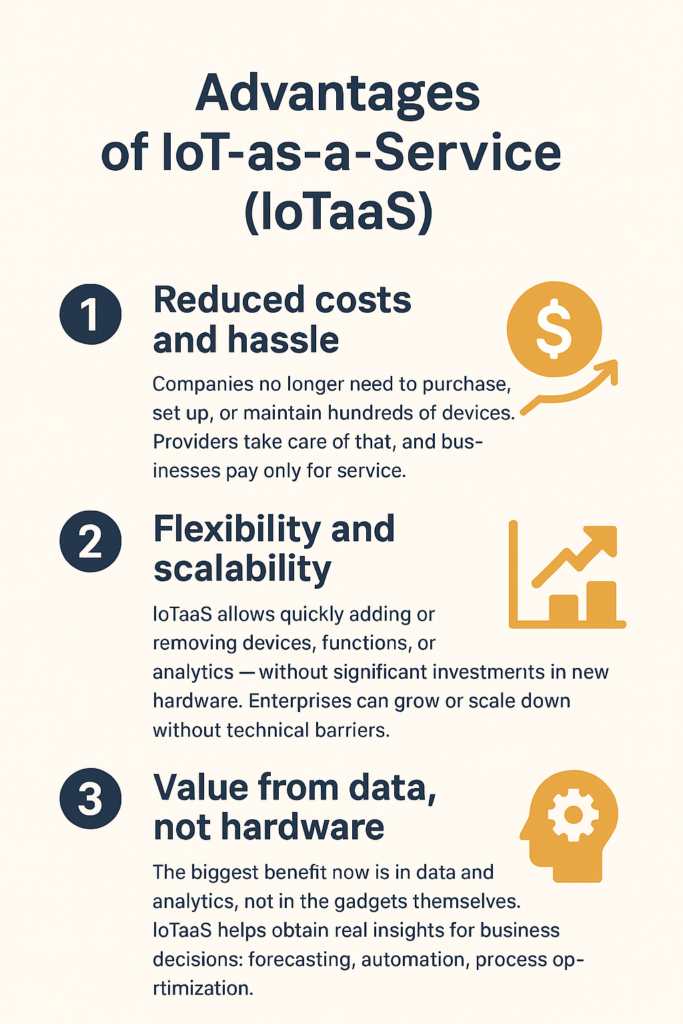
- IoTaaS offers clear advantages for both sides of the market:
- Scalability: Businesses can add or remove devices and services on demand.
- Cost Efficiency: Subscription pricing eliminates heavy upfront investments.
- Faster Innovation: Providers can roll out updates and new features instantly across all customers.
- Focus on Core Value: Customers spend less time managing infrastructure and more time using data for business growth.
- Ultimately, IoTaaS turns IoT from a technical challenge into a business enabler.
- Challenges: Security, Standardization, and Trust
With great connectivity comes great responsibility. As IoT moves toward service-based models, data security, privacy, and regulatory compliance become critical.
A single vulnerability in one connected device could expose an entire platform — and, by extension, all its users. That’s why encryption, zero-trust architecture, and strong identity management must be built into every layer of an IoTaaS platform.
Another barrier is standardization. The IoT ecosystem is fragmented — thousands of devices, protocols, and vendors that don’t always “speak the same language.” Achieving interoperability across hardware and cloud services is a major challenge that the industry must overcome.
And finally, trust is everything. Customers need transparency about how their data is collected, stored, and used. Providers who prioritize ethical data governance will have a long-term competitive advantage.
The Road Ahead
The shift from selling devices to offering data-driven platforms marks a turning point in the IoT industry. IoT-as-a-Service represents a smarter, more sustainable model, focusing on continuous value instead of one-time hardware sales.
By combining connectivity, analytics, and automation, IoTaaS enables businesses to innovate faster, scale effortlessly, and remain competitive in an increasingly digital economy.