
✆ + 1-646-235-9076 ⏱ Mon - Fri: 24h/day
From Prototype to Platform: When It’s Time to Rethink Your Architecture


Every great product starts as a prototype or an idea shaped into code to test viability. But at some point, it needs to evolve from “something that works” into “something that delivers”. Delivers something stable and useful for humanity.
That transformation from prototype to platform is one of the most critical moments in a product’s lifecycle.
What Is a Prototype and PoC in the IT World?
In the IT world, a prototype or Proof of Concept (PoC) is a simplified, disposable version of a system built to validate an idea. It’s not designed for scale or uptime; it’s designed to prove that some problem may be solved in a particular way to deliver the value of the service or product.
A prototype helps you:
- Validate a technical hypothesis, e.g., “Can this API handle thousands of requests per second?”
- Validate a business hypothesis: “Will users actually pay for this?”
- Identify early design and usability flaws.
- Understand cost drivers before you overcommit.
A PoC usually targets technical feasibility:
“Can we connect this IoT device to the cloud and receive metrics in real time?”
A prototype focuses more on interaction and workflow:
“Can users manage and monitor these devices intuitively?”
In either case, the goal is speed. Teams intentionally take shortcuts using hardcoded credentials, manual deployment, or monolithic scripts because time to validation is more important than perfection.
But those shortcuts, if carried into production, often become technical debt.
Why Companies Need a Prototype First
Before investors, clients, or internal leadership commit to a full product launch, they need proof that the idea works, the demand exists, and the technology is achievable.
That’s where prototyping comes in.
For Startups
Startups live on borrowed time and limited funding. A good prototype helps secure seed investment, attract co-founders, and test the market response before scaling.
No investor will fund an idea based on slides alone; they want a working demo, agree?
For Enterprises
In large organizations, innovation faces bureaucracy. A PoC or prototype allows innovation teams to experiment independently without disrupting production systems. It’s a way to de-risk experimentation and prove ROI to stakeholders.
For Business Plans and Funding
A working prototype validates not only the technology but also the economics, operational cost, expected scaling expense, and cloud usage patterns.
Many successful startups have used prototypes to attract partnerships and grants long before launching.
In short, the prototype is your business pitch in motion.
What Is a Production-Ready Platform?
A production-ready platform is a system engineered not just to work but to last and be reliable.
It’s built with resilience, automation, and modularity at its core. It’s secure enough to handle regulation, scalable enough to support growth, and flexible enough to evolve with new business requirements.
Key Traits of a Production Platform
| Attribute | Description |
| Stable | Can withstand high traffic and unpredictable loads without outages. |
| Secure | Includes proper IAM, network segmentation, and encryption. |
| Scalable | Can handle increased demand horizontally (via containers, clusters) and vertically (via instance sizing). |
| Observable | Monitored, logged, and alert-driven to prevent silent failures. |
| Automated | Uses CI/CD pipelines, backups, and self-healing infrastructure. |
| Flexible | Modular design allows replacing components or even entire subsystems without re-architecting everything. |
This is the stage where a business can onboard new clients, operate globally, and recover quickly from any disruption.
When and How to Rethink Your Architecture
The truth is, architecture is never final. What works for ten users will collapse under ten thousand. What’s “fast” in a sprint can become an anchor in production.
So when is it time to rethink?
Signs You’ve Outgrown the Prototype:
- Frequent downtime or inconsistent performance
- Scaling requires manual intervention
- Security compliance becomes mandatory (GDPR, HIPAA, PCI DSS)
- The system relies on scripts and manual builds
- Adding new features causes unexpected regressions
Architectural Philosophy: Always Stay Flexible
From my experience and echoed by many respected IT architects, a good architecture is one that anticipates change.
You can’t predict the next five years, but you can design systems that will adapt to them.
That’s where modern engineering principles come in:
Containerization
Docker and Kubernetes abstract the runtime environment from infrastructure. Whether your containers run on AWS, Azure, on-premises, or in a private data center, the stack remains consistent.
DevOps & CI/CD
Automating deployment, testing, and recovery through CI/CD pipelines eliminates human error and shortens release cycles. DevOps is your bridge between flexibility and reliability.
Infrastructure as Code (IaC)
Using tools like Terraform, Pulumi, or Ansible, you define infrastructure declaratively. That means:
- The same environment can be recreated anywhere.
- Configuration drift is eliminated.
- Migration between clouds or DCs becomes a matter of code, not manual setup.
Cloud-Agnostic Architecture
Avoid deep coupling with proprietary cloud features (e.g., serverless runtimes or managed data pipelines).
Instead, rely on standardized layers: containers, databases, message queues, and APIs that exist across all major providers.
In practice, this means choosing PostgreSQL over vendor-locked databases, or Kafka over proprietary streaming tools, giving your architecture a “way out” if needed.
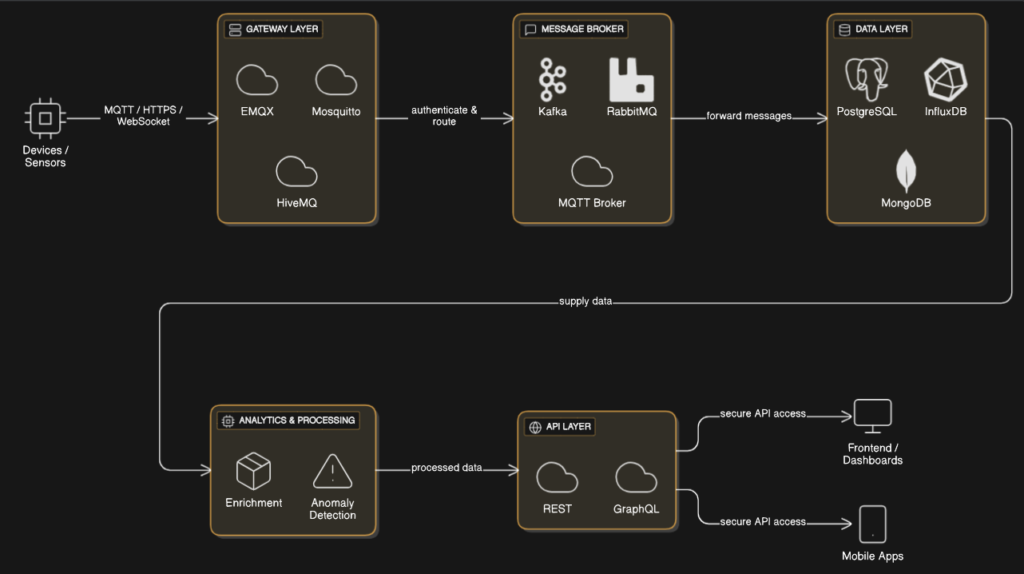
Example of a Proven Flexible IoT Architecture on AWS (and Beyond)
A flexible IoT architecture doesn’t depend on any single provider. It uses portable components and standardized protocols.
Reference Example Cloud-Agnostic IoT System
Why It’s Flexible
- Uses open-source, cloud-portable technologies.
- Can run entirely on AWS (ECS, EC2, or EKS) or shift to Azure or on-prem with minimal code change.
- No dependency on managed pipelines or vendor-specific services.
- All infrastructure defined in Terraform is reproducible anywhere.
- Perfectly suited for IoT, industrial, or automotive workloads.
This model demonstrates what true flexibility looks like a platform that can evolve or relocate as the business grows or regulations change.
How Fordewind.io Helps Build Future-Ready Platforms
At Fordewind.io, we specialize in guiding companies through the critical evolution from idea to infrastructure.
We’ve worked with startups refining MVPs and global corporations scaling platforms in sectors like healthcare, finance, e-commerce, and connected devices.
What We Deliver:
- Architecture Audits & Redesigns: Evaluate your current structure, identify bottlenecks, and propose modernization paths.
- Cloud-Agnostic Solutions: Deploy across AWS, Azure, GCP, or private clouds without vendor lock-in.
- IoT Expertise: Real-time data processing from EV chargers, Mitsubishi car sensors, smart locks, and smart homes.
- Infrastructure as Code Pipelines: Reproducible, versioned infrastructure for multi-environment setups.
- End-to-End DevOps Integration: CI/CD, monitoring, alerting, and automated recovery built in from day one.
- Security & Compliance-Driven Design: Encryption, IAM hardening, and regulatory alignment across sectors.
I like the philosophy: “Build once, deploy anywhere.” That’s what future-proof architecture means.
Conclusion
Prototypes are meant to test ideas, platforms are meant to sustain them.
The key is knowing when to evolve, and doing it without locking your business to one provider or design.
A well-architected platform is:
- Flexible enough to change.
- Stable enough to scale.
- Portable enough to migrate.
At Fordewind.io, we help companies make that leap by building infrastructures that don’t just meet today’s needs but are ready for tomorrow’s evolution.
Because technology changes fast, but great architecture adapts faster.