
✆ + 1-646-235-9076 ⏱ Mon - Fri: 24h/day
Human Digital Twins: Modeling People in the Digital Age

Imagine a system capable of accurately reproducing the state of the human body – not only physiological indicators such as heart rate or blood pressure, but also behavior and the way a person makes decisions. This concept lies at the core of the Human Digital Twin (HDT) – a digital representation of a person created from multidimensional data collected from sensors, medical devices, wearable gadgets, surveys, and observational data. It may resemble the next stage of a conventional digital profile, but not one that simply reflects basic input information such as age, gender, and so on. Instead, an HDT is a dynamic model that is continuously updated in real time, responding to changes in a person’s physiological state or behavior.
The origin of digital twin technology goes back to industry, where companies began developing Digital Twins to model technical systems such as engines, spacecraft, or production lines. The goal was to predict failures, optimize performance, and reduce risks. From the very beginning of such developments, someone likely imagined creating the same kind of model for a human being. Today, with the advancement of biotechnology, the Internet of Things (IoT), and artificial intelligence, this idea is finally moving beyond the purely technical domain and can now be used to model the human being as a biological system.
How Create Human Digital Twins And How It Works
How to create a digital twin of a human? It’s simple. You only need two things: a lot of time and a lot of money. But seriously – to create a true digital twin of a person, you need a constant stream of data that reflects not only the state of the body, but also the full context of that person’s life. The sources of such data include biometric sensors, medical devices, fitness trackers, smartwatches, and even social media activity. Heart rate, blood oxygen levels, sleep quality, physical activity, stress levels, eating habits, emotional reactions – all of this can become part of a comprehensive model. Even communication patterns or the frequency of online activity can serve as behavioral indicators that complement physiological data.
These data are not just stored – they are merged, analyzed, and transformed into a dynamic model that can reflect a person’s state almost in real time. The resulting digital copy is then able to respond to changes in the real person: for example, if someone is sleep-deprived, the system can detect it from heart rate and sleep quality; if stress levels rise, the system can predict fatigue or reduced concentration and, for instance, advise against driving at that moment.
It’s worth noting that the key element of such a system is an artificial intelligence model, which is what makes the whole concept realistic and technically feasible. This AI must continuously learn from the collected data to draw conclusions and make predictions. The model can suggest when to take a break, warn about the risk of illness, or even simulate how the body might respond to a new treatment. Over time, the digital twin becomes increasingly accurate – the more data it receives, the better it understands its real-world counterpart.
Applications Across Fields
We’ve figured out how HDT works and what’s needed to build such a system. Now it’s worth looking separately at why this system is actually being created.
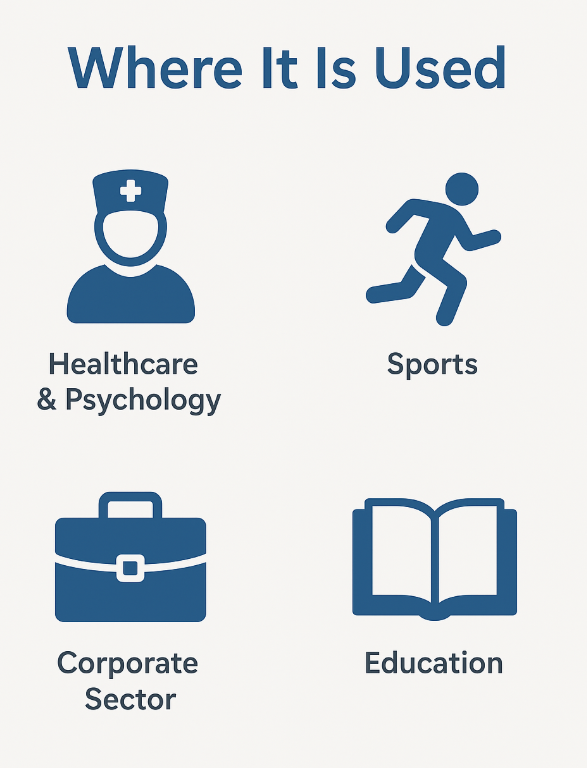
It’s best to start with healthcare – one of the most obvious and at the same time most important areas of application. Thanks to digital twins, it becomes possible to create truly personalized treatment plans that take into account the individual characteristics of the body, genetics, and lifestyle. These models help doctors predict how a patient might respond to a particular drug or therapy even before it begins.
In psychology and behavioral sciences, digital twins can analyze emotional states and behavioral patterns. They are able to detect changes in voice tone, heart-rate rhythms, or facial expressions to identify signs of stress or depression. Such systems can help predict a person’s reactions to certain events, opening new opportunities for therapy or mental health support.
In sports and fitness, the Human Digital Twin becomes a tool for precise monitoring of physical condition. Based on data about workload, recovery, and nutrition, it can suggest optimal training programs, minimizing the risk of injury and increasing training efficiency. For professional athletes, this means the ability to track the body’s state down to the smallest details; for ordinary people – having a personal coach with deep understanding of their body.
In the corporate sector, HDT is used to model employee behavior and even predict team dynamics. Companies can assess how changes in the work environment or stress factors will affect productivity. In the future, this could help with hiring – for example, by creating digital models of candidates to test how well they would adapt to specific conditions or teams.
In education, digital twins open the way to truly adaptive learning. A “digital student” can show which topics are mastered better and where additional support is needed. Such models can create personalized learning programs that adjust to the student’s pace, interests, and even emotional state.
Core Technologies Behind HDT
The technologies that made the concept of the Human Digital Twin possible are the result of convergence between several modern fields of science and engineering. It stands at the intersection of artificial intelligence, bioengineering, the Internet of Things, and computer modeling. Without these components, creating a dynamic digital copy of a person would be impossible.
Let’s start with the core: Machine Learning (ML) and Predictive Analytics. It is machine-learning algorithms that analyze massive data streams coming from sensors, wearable devices, and medical systems to detect patterns, build behavioral and physiological models, and – as mentioned earlier – serve as the brain of the entire system.
An equally important role is played by the Internet of Things (IoT) and its biological branch – Bio-IoT. These systems provide a continuous flow of data from sensors and devices that capture a wide variety of parameters: heart rate, blood oxygen levels, muscle activity, sleep quality, eating habits, or even emotional responses. Next-generation bio-sensors embedded in skin or worn as gadgets transmit this data in real time, creating a living foundation for the constant updating of the digital twin.
Another key element is Digital Modeling & Simulation technologies – the modeling and simulation of human processes in a digital environment. Thanks to complex mathematical and biophysical models, the HDT can replicate the functioning of organs, the responses of the nervous system, or human behavior in stressful situations. For this purpose, predictive analytics algorithms are used to run what-if simulations, helping to assess the consequences of certain actions or lifestyle changes. For example, a digital twin can simulate how the body will respond to a new medication or how performance will change with an altered sleep schedule.
Privacy and Consent in Digital Twin Systems
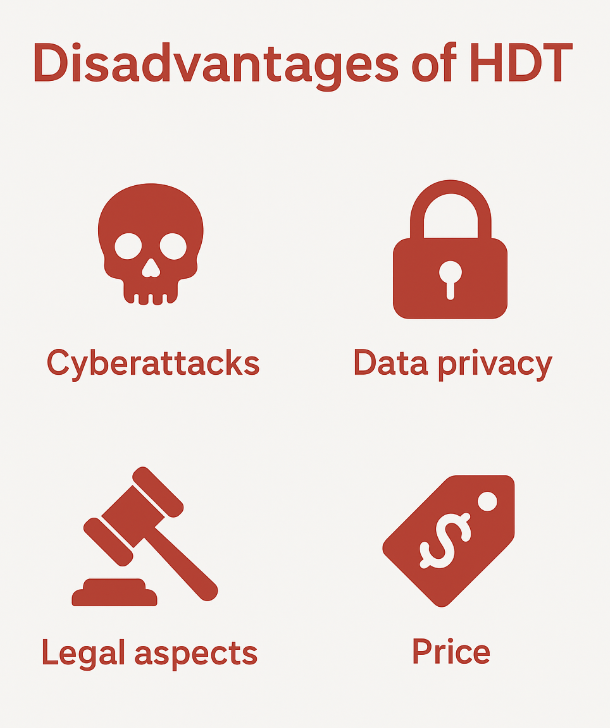
One of the most sensitive aspects of using Human Digital Twins (HDT) is privacy protection and the user’s right to control their own data. Since digital twins contain a complete set of personal information – from genetic data and medical indicators to behavioral patterns – security becomes a critical issue not only technically, but also ethically. The concept of «Digital Self-Sovereignty» means that every person is the sole owner and manager of their digital copy, with the right to decide which data are collected, how they are used, who they can be shared with, and when they must be deleted. To ensure privacy, strong data encryption (AES, RSA), multi-factor authentication, data anonymization, and differential privacy techniques are employed, allowing large datasets to be analyzed without revealing the identity of a specific individual.
The concept of Federated Learning is actively developing, where artificial intelligence trains on local devices without sending raw data to a central server. From a legal perspective, HDTs are governed by regulations such as GDPR in Europe and HIPAA in the United States; however, existing standards do not always fully cover the complexity of digital twins, since we are dealing with digital projections of a person’s identity. Therefore, there is a growing need for special legislative initiatives that would guarantee a person’s right to their digital twin, including the right to digital erasure and digital autonomy.
Case Studies and Emerging Projects
Siemens describes a project in which a digital patient twin is created that continuously receives data – including blood pressure, oxygen saturation, ECG, and activity – and compares them with clinical groups of people to predict disease progression. In the article «What is a digital patient twin?» Siemens explains that such a system enables physicians to create individualized diagnostic and treatment plans based on the analysis and modeling of the patient’s digital copy.
Philips is developing heart simulation models that allow doctors to test different treatment scenarios before procedures. For example, the HeartModel technology automatically extracts heart anatomy from ultrasound images and models cardiac function, helping to predict intervention outcomes. In this context, the digital patient twin makes it possible to test a treatment before applying it, reducing risks and increasing the precision of interventions.
Duke Center for Computational and Digital Health Innovation is developing holistic patient models, including the heart or lungs, that integrate data from wearable sensors and medical imaging to predict intervention outcomes and avoid complications.
Conclusion
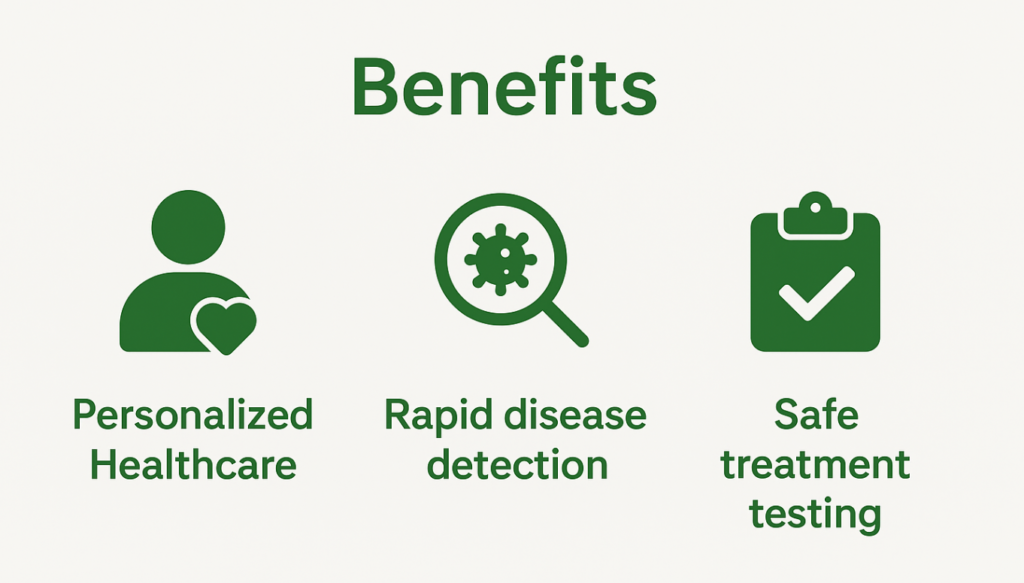
Human Digital Twins demonstrate how modern technologies can replicate not only a person’s physiological indicators, but also behavioral patterns and decision-making processes. They usher in a new era of personalized medicine, where it becomes possible to predict responses to treatment, test therapeutic scenarios without risk to the patient, and receive adaptive lifestyle recommendations. Beyond medicine, HDTs enable analysis of behavior in education, sports, corporate environments, and psychological research, creating opportunities for safe decision modeling and process optimization.
At the same time, the adoption of digital twins is accompanied by numerous challenges. These include data security and privacy concerns – particularly who has access to a person’s digital representation and their data – as well as bioethical issues. Additional risks involve potential psychological impact on users, unequal access to the technology, and legal uncertainty regarding decisions made by a digital twin.
That is why the concept of Digital Self-Sovereignty is a critical component of HDT development: it guarantees a person’s right to control their own digital copy, ensures encryption and differential privacy, upholds ethical standards, and complies with regulatory requirements such as GDPR, HIPAA, and similar frameworks. The key task is to create technologies that empower human capabilities rather than replace them, while maintaining transparency and trust in the interaction with digital twins.
The future of HDT can be envisioned as a coexistence between a person and their digital reflection. Digital twins will become tools for decision-making, risk prevention, and improving quality of life – while preserving human values and autonomy. Finding the balance between technology, privacy, and humanity will determine whether digital twins become a true part of our identity or remain merely a collection of data.