
✆ + 1-646-235-9076 ⏱ Mon - Fri: 24h/day
Blockchain and IoT in Agriculture: Ensuring Food Supply Chain Transparency

Every day, we place our trust in strangers and complex logistics chains to deliver the food we eat. Yet the statistics are alarming: one-third of all food (≈1.3 billion tons) is lost or wasted before it reaches the consumer. Data shows that only one in four consumers trusts the modern food system; 80% of consumer goods companies still rely on paper-based processes, and one in five seafood samples is mislabeled.
This lack of trust and transparency creates serious threats to public health and national economies. Frequent crisis-related product recalls force retailers to destroy tons of food. The challenge is clear: how can we ensure transparency and trust in the food we consume? This is where blockchain and Internet of Things (IoT) technologies come into play.
Problem and Challenge for Agri-Food Supply Chains
Fragmented data and paper-based processes
The food supply chain consists of many stages: cultivation, harvesting, processing, logistics, retail. At each stage, records are kept, but they are often isolated. Most transactions are still recorded on paper. This creates:
- Delays in traceability: when contamination is suspected, tracing a product’s journey from farm to shelf can take days. A well-known case showed that identifying the source of mangoes took seven days with a traditional system, while blockchain reduced this to just 2.2 seconds.
- Opportunities for fraud: economically motivated adulteration (ingredient substitution, mislabeling) is estimated at $10-15 billion annually.
- Unproductive losses: 33% of fresh produce is discarded due to noncompliance with standards or inaccurate demand forecasting.
Growing demand for traceability and sustainable products
Consumers increasingly want to know the origin of their food, demand ethical standards, organic certification, and lower environmental impact. Demand for local and seasonal products, certified meat, coffee, honey, wine, or spices is rising. At the same time, governments and import markets are enforcing stricter rules on traceability and carbon footprint reporting. Without transparency, farmers and distributors lose access to lucrative markets, while consumers lose trust.
Cyber and climate challenges
Climate change causes unstable yields, more frequent droughts, new pests, and diseases. Adaptation requires accurate data on soil, weather, and vegetation. Analysts estimate that the agricultural IoT market grew from $16.24 billion in 2024 to $17.78 billion in 2025, and will surpass $40 billion by 2034 (CAGR ≈ 9.5%). IoT sensors can achieve 92% accuracy in detecting plant diseases and reduce water use by up to 50%.
How Blockchain and IoT Solve the Problem
Internet of Things (IoT): from field to cloud
IoT sensors are installed in fields, warehouses, and transport containers. They collect data on temperature, humidity, pH levels, light conditions, and location. This information is transmitted through an edge gateway to a cloud platform, where AI algorithms analyze it for early disease detection or yield prediction. Studies show that IoT in agriculture can reduce risks by up to 98% through predictive analytics and cut water consumption by 50% thanks to precision irrigation systems.
Key benefits of IoT:
- Real-time monitoring: farmers receive instant alerts about changes in temperature or humidity, allowing timely interventions.
- Automation: integration with smart pumps and drones enables automatic irrigation or fertilization only where needed, reducing costs.
- Analytics: large data sets are used for more accurate yield forecasting, logistics optimization, and waste reduction.
Blockchain: a trusted ledger of transactions
Blockchain is a distributed ledger where data is stored in blocks linked together and secured by cryptographic hashes and consensus protocols. Blockchain-based systems provide several unique properties:
- Immutability: once recorded, data cannot be altered or deleted – essential for safety protocols and auditing.
- Decentralization: data is replicated across all network nodes, eliminating a single point of failure or central authority.
- Transparency: all participants can access a verified transaction history, creating trust while maintaining confidentiality through cryptography.
- Smart contracts: programmable modules that automatically execute agreements (e.g., payment upon confirmed delivery). These reduce paperwork, processing times, and human errors.
IoT + Blockchain: end-to-end visibility
Integrating blockchain with IoT minimizes manual entry errors and delivers end-to-end supply chain visibility, enabling efficient tracking of products from origin to consumer. Together, these technologies provide rapid detection of safety breaches, automated interactions between stakeholders, and stronger consumer trust.
Real-World Implementation Examples
To illustrate the practicality of these technologies, let’s review several global cases that demonstrate the effectiveness of blockchain and IoT in the food sector.
Walmart and IBM Food Trust
In 2017, Walmart and IBM launched a pilot project to track Mexican mangoes on the blockchain. Walmart’s VP of Food Safety measured the time it took to trace the origin of sliced mangoes using traditional methods – it required seven days. After moving to blockchain, the process took just 2.2 seconds. This reduction in time allows retailers to recall only specific batches if needed, instead of destroying all stock, cutting both waste and losses.
The project later expanded to pork and other products, with Walmart scaling the system to 400 stores. Through IBM Food Trust, Carrefour and Auchan are also tracking pork, poultry, and eggs, with plans to include eggplants, mangoes, and more. Beyond faster response times, this initiative builds consumer trust: a QR code on packaging allows customers to view the product’s journey in just a few clicks.
TE-FOOD
TE-FOOD is one of the largest food traceability projects worldwide. Used by over 6,000 companies, it processes more than 400,000 transactions per day and covers 30 million consumers. Farmers label products, while data about their condition and transport is uploaded to the network. Consumers can scan a QR code to see the entire history – from farm to shelf.
Carrefour and Safety4Food
French retailer Carrefour was among the first to adopt blockchain for tracking chicken and microgreens. Shoppers can scan a QR code to see details about the farm, feed, and transport conditions. In Italy, Barilla partnered with Cisco and NTT Data to create Safety4Food, a platform that uses sensors, wireless networks, and cloud analytics to monitor basil and tomato cultivation, storing the data on blockchain. Consumers receive a “digital passport” of pasta sauce, showing its journey from farm to factory. Barilla even received Italy’s first award for blockchain use in the food industry.
Additionally, blockchain is being used in Italy to certify buffalo mozzarella and other products via NFC/QR tags.
HoneyTrace: Fighting Honey Fraud
Honey is considered a natural product, yet it is one of the most frequently adulterated foods. According to the European Commission’s Joint Research Centre, about 14% of honey on the global market is counterfeit or mixed with sugar syrups. In 2024, Intertek launched HoneyTrace, a blockchain platform for tracking honey from hive to jar. The system allows producers, exporters, and packagers to track each batch, reducing opportunities for fraud and ensuring authenticity. HoneyTrace records beekeeper data, lab test results, and logistics on the blockchain – vital for meeting new EU honey origin labeling requirements. According to Intertek’s Business Assurance division, the solution provides a secure platform to protect both consumers and producers.
How IoT and Blockchain Integration Works
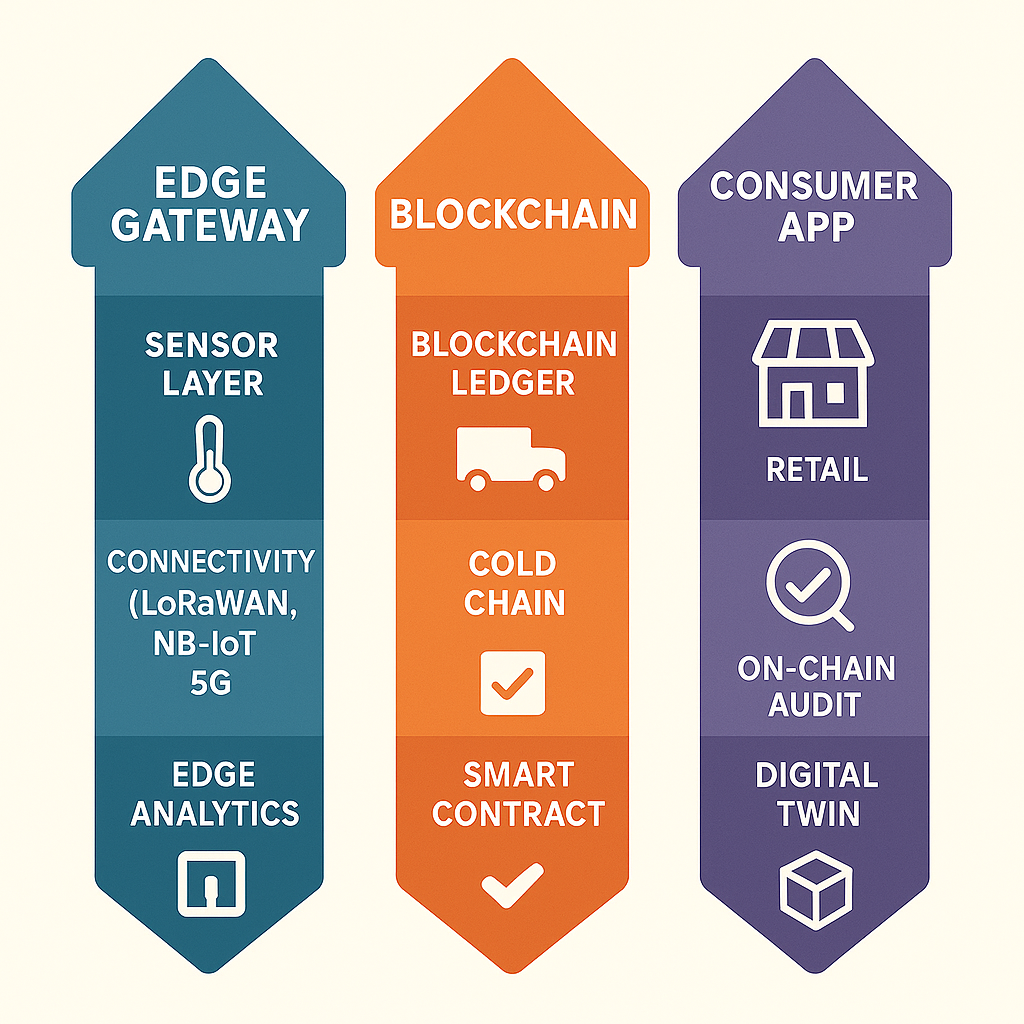
Source: Image generated via ChatGPT 5 by Volodymyr Kazakov
The combination of IoT devices with blockchain opens a new level of transparency and trust in supply chains. Sensors collect data, cloud services analyze it, and blockchain ensures the reliability and immutability of records. As a result, all participants – from farmers and logistics providers to retailers and consumers – gain access to a single source of truth.
Key Integration Stages:
- Data collection and validation: IoT sensors capture temperature, humidity, location, and other parameters. At the gateway level, data is cleaned, digitally signed, and sent to the cloud.
- Cloud processing and analytics: the cloud aggregates data streams, detects anomalies (e.g., container overheating), and predicts risks. Farmers and suppliers receive visualized insights in a convenient format.
- Blockchain recording: key events – cultivation, certification, transportation, delivery – are logged in the blockchain. Smart contracts automatically execute payments upon confirmation or initiate refunds if conditions are violated. Data cannot be altered, creating a transparent and trusted environment for all parties.
- Role-based access: systems provide role-based access to data: farmers can view crop history and agronomy recommendations; logistics companies monitor storage conditions; retailers and consumers verify origin and certifications; regulators conduct audits and oversight.
Standards and Protocols for Integration
The efficiency of this model relies on interoperability:
- LoRaWAN and MQTT: can work together to create efficient IoT solutions. LoRaWAN provides the connectivity for low-power, long-range communication between devices, making it ideal for sensors deployed in the field with limited energy resources. MQTT (Message Queuing Telemetry Transport) then simplifies data processing and exchange between those devices and cloud services using a lightweight publish-subscribe model. In practice, this means that sensors transmit data via LoRaWAN to a gateway, which forwards it to an MQTT broker. From there, applications and analytics platforms can subscribe to relevant data streams, enabling real-time monitoring, alerts, and automation.
- GS1 and EPCIS Standards: GS1 is a global standard for product identification (barcodes, RFID, QR codes) that ensures unified tracking and management of goods throughout the entire supply chain. EPCIS (Electronic Product Code Information Services) complements GS1 by describing events: what happened, where, when, and why. It enables sharing details about shipping, transport, or storage conditions in a format understood by all stakeholders. When combined with IoT and blockchain, these standards guarantee transparency and interoperability across systems – from farm sensors to consumers in retail stores. For example, by scanning a QR code on the packaging, a customer can instantly see the product’s origin and storage conditions at every stage of its journey.
- Hyperledger and Ethereum: leading platforms for IoT-Blockchain integration. Hyperledger Fabric is widely used in corporate networks for quality control, certification, and data exchange. It ensures confidentiality, scalability, and permissioned access, making it ideal for enterprises that need secure internal operations. Ethereum is best suited for public scenarios: smart contracts, transparent product traceability, and automated payments. Its open nature makes it a strong tool for building consumer trust and enabling seamless interactions across partners. By combining both models, companies can operate securely within private environments while still opening selected data to partners and consumers. This hybrid approach is becoming central to projects where IoT sensors generate data and blockchain guarantees its authenticity.
By integrating IoT and blockchain, agribusinesses gain not only real-time control over equipment and crops but also trust from consumers and partners. This approach ensures supply chain transparency, minimizes fraud risks, and creates a foundation for sustainable agricultural development.
Fordewind: Trusted Expertise in IoT Solutions
Modern agri-food supply chains require more than just technology – they demand expertise and vision to seamlessly integrate innovation into real processes. Fordewind brings years of proven experience in designing and implementing IoT solutions, helping businesses enhance efficiency, transparency, and competitiveness.
What Sets Fordewind Apart
- Broad expertise. We work with IoT across multiple domains – from agriculture to manufacturing, transportation, and smart homes.
- End-to-end approach. We deliver the full cycle – from data collection to analytics and process management.
- Scalability. Our solutions are suitable for both small family farms and large enterprises.
- Proven results. We help clients cut costs, reduce risks, and unlock access to new markets.
If you are looking for a reliable partner to drive your company’s digital transformation with IoT, Fordewind is ready to guide you through the process. By combining cross-sector expertise, cutting-edge technologies, and a deep understanding of market challenges, we create solutions that deliver real impact.
Our team can help you integrate IoT devices, organize data collection and processing, build transparent supply chain processes, and elevate your business to a new level of efficiency.
Conclusions
The global food system is undergoing a profound digital transformation. Today, billions of people depend on supply chains that must be transparent, safe, and resilient. Traditional methods are no longer sufficient: waste, distrust, and fraud cost society enormous resources each year and put consumer health at risk.
IoT and blockchain technologies open new possibilities – from sensors that monitor growing and storage conditions to smart contracts that automatically execute agreements. Their adoption delivers:
- instant product traceability,
- reduced costs and waste,
- protection against counterfeits,
- access to premium markets,
- increased consumer trust.
Real-world examples – Walmart, Carrefour, HoneyTrace, TE-FOOD – prove that these technologies are already working and delivering tangible results. At the same time, large-scale deployment requires unified standards, investment, education, and strong partnerships between public and private stakeholders.
Who can act today?
- Farmers and cooperatives: pilot IoT sensors and blockchain-based solutions, leverage grant programs, and seek partners for implementation.
- Processors and retailers: integrate digital traceability systems, enhance transparency, and form consortia to reduce costs.
- Policymakers: create favorable conditions for digital innovation, support supply chain transparency, and protect producers’ data.
- Consumers: choose brands with verifiable product histories, use QR codes, and support businesses that embrace innovation.
Only through collective effort can we build the food system of the future – one that is safe, environmentally responsible, and fair to all stakeholders.