
✆ + 1-646-235-9076 ⏱ Mon - Fri: 24h/day
Connected Wildlife: How IoT and AI Could Protect Endangered Species

In the 21st century, humanity is still struggling with the problem of biodiversity loss on our planet. Deforestation, climate change, pollution, urbanization, and poaching are all destroying natural habitats, disrupting ecosystems on which countless species on Earth depend. According to the Intergovernmental Science-Policy Platform on Biodiversity and Ecosystem Services (IPBES), about one million species of plants and animals are now at risk of extinction within the next few decades.
This is a sad statistic, and of course, people are already fighting this problem. Many methods are currently being used to control it, at least to prevent the situation from getting worse. It cannot be said that outdated devices or methods are used for this purpose. I would say that equipment is constantly being upgraded and modern technologies are applied, but often their work ultimately comes down to manual control or manual processing of the collected data. This may not sound like a serious issue, but it can become one if there are not enough people or financial resources to maintain an acceptable level of efficiency.
Fortunately, progress does not stand still, and new opportunities are emerging to increase the effectiveness of efforts to monitor and preserve ecosystems on our planet. AI and IoT can help by integrating all monitoring devices into a single system, enabling not only the processing of collected information but also the creation of response plans for various situations.
The Concept of Connected Wildlife
This system describes a modern technological ecosystem in which devices work together to monitor, analyze, and protect wildlife. It combines sensors, GPS trackers, wireless networks, satellites, and analytical platforms to create a unified information space for tracking the state of ecosystems and endangered species of animals and plants in real time.
The main idea of this approach is to build a data cycle that limits human involvement to critical decision-making or partially reduces the workload. Functionally, the system can be described as follows: data collection → transmission → analytics → automatic actions or real-time alerts.
Architectural Model of an Intelligent Monitoring Ecosystem
Such a cycle would divide the system into several software layers. The first of these layers performs the data collection function and consists of various devices. Types of devices that can form this layer include:
- GPS trackers – attached to animals to track migration routes, behavioral changes, or danger signals (for example, a sudden drop-in activity).
- Camera traps – automatically activated by motion, capturing not only images but also context such as time, temperature, and the activity of other species.
- Acoustic sensors – used to monitor bird songs, insect movement, or even vehicle noise near reserves, helping to assess the level of human impact on nature.
- Drones – used for aerial monitoring of large areas, especially in hard-to-reach regions where human presence may be dangerous or inefficient.
- Satellite systems – provide macro-observation of climate changes, deforestation, fires, or the movement of large animal populations.
- Static sensors – monitor the living environment of animals and the growth of plants..
The next layer in the system would be responsible for transmitting and processing the collected data. This would be handled by special hubs placed near the devices to accumulate their data. The collected information would then be sent either to a local server or to the cloud. The key aspects of this layer are ensuring reliable connectivity with devices and implementing an artificial intelligence model for data analysis. Mobile or satellite communication technologies can be used for data transmission. The analytical part can be implemented through AWS IoT Core or Google Cloud IoT, which support integration with machine learning models for detecting anomalies or predicting animal behavior in real time.
The following layer should be responsible for responding to changes or issuing alerts. In short, this is the layer that provides convenient access to collected information and analytics for system users. Based on the accumulated knowledge, it should enable preventive or reactive actions in response to various critical changes — for example, dispatching a medical or rescue team.
The system can be schematically described as follows:
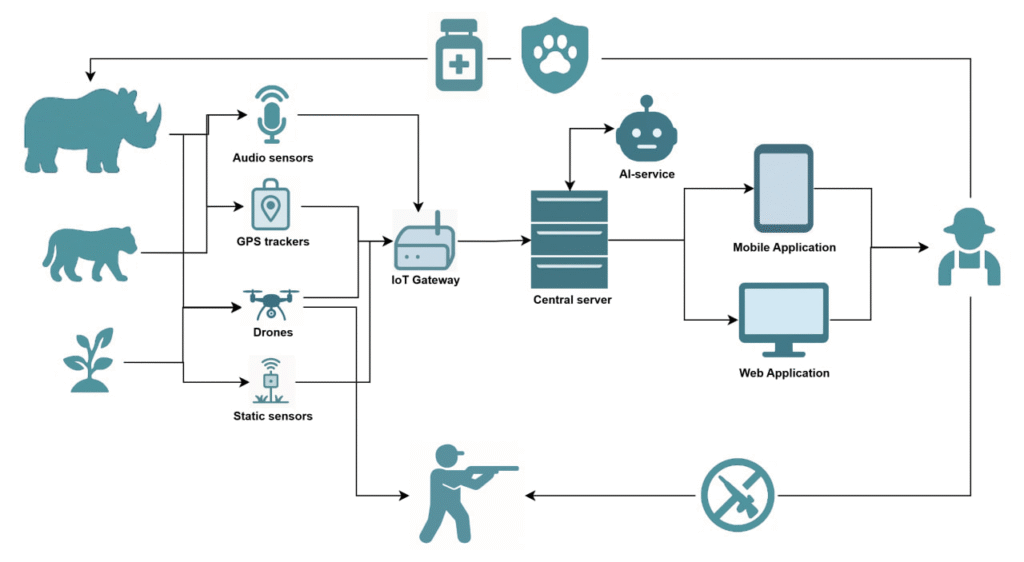
Together, these layers create the so-called «smart wildlife network» in which information from multiple sources is integrated into a single system. This makes it possible not only to see the overall picture but also to identify patterns that help predict risks – for example, potential migration conflicts between animals and human settlements, or the likelihood of poachers appearing in specific areas.
The Role of Artificial Intelligence
It is also worth considering the role of artificial intelligence. One of the key applications is recognizing what is shown in photos, videos, or audio recordings using computer vision and audio AI technologies. Models based on TensorFlow, PyTorch, or OpenCV can identify animals even from partial images or under challenging lighting conditions. For example, WWF and Google projects use systems that automatically classify thousands of images from camera traps, reducing analysis time from months to just a few hours.
Another important area of AI application is detecting anomalous behavior. Machine learning algorithms can analyze animal movement data from GPS trackers and identify deviations that may indicate injury, stress, or changes in migration routes. Such models are typically based on Recurrent Neural Networks (RNN) or LSTM networks, which effectively process time series data. When suspicious behavior is detected, the system can send real-time alerts.
AI models also play a key role in predicting poaching risks or natural disasters. Using data from surveillance cameras, satellites, and sensors, algorithms based on predictive analytics can estimate the likelihood of poachers appearing in certain areas or forecast fires and floods. This enables preventive action rather than merely reactive response.
Comparative Table: Benefits and Impact vs Challenges and Ethical Considerations in the Context of IoT for Wildlife Conservation
| Aspect | Benefits and Impact | Challenges and Ethical Considerations |
| Purpose of Application | Enhancing wildlife safety and conservation efficiency | Ensuring system stability, cybersecurity, and minimal interference with nature |
| Ecosystem Research | Creating a complete and accurate real-time picture of animal life | Risk of data distortion or inability to collect information in hard-to-reach areas |
| Impact on Rescue Operations | Enabling preventive response: early detection of diseases, threats, and poachers | Dependence on power supply and connectivity, maintenance difficulties |
| Analytics and Forecasting | Predicting migrations, behaviors, and seasonal risks | Complexity of data standardization and exchange across countries and organizations |
| Technological Effect | Optimizing patrol and monitoring resources, reducing human error | High cybersecurity and device authentication requirements |
| Impact on Animals | Minimal human interaction with habitats, enabling stress-free research | Risk of disrupting natural behavior due to technical devices |
| Scalability of Implementation | Creation of global databases for scientific research | Need for international policies and unified standards |
The use of IoT for wildlife protection demonstrates significant potential – monitoring systems to help safeguard animals, reduce poaching, and generate valuable scientific data. However, the implementation of such solutions is impossible without considering technical, ethical, and political factors, as their proper management determines whether these new technologies will truly become a tool for preserving ecosystems.
Case Studies and Global Initiatives
One of the most well-known examples of combining IoT and artificial intelligence in wildlife conservation is the EarthRanger project, created by Vulcan Inc. in collaboration with Save the Elephants. This system is used in African national parks to track the movement of elephants and rhinos in real time. The animals are equipped with GPS collars that transmit their coordinates to a central platform via satellite or radio networks. The collected data is then analyzed by machine learning algorithms that detect suspicious behavior – for instance, a sudden stop in movement that may indicate danger or poaching. This approach enables immediate response to incidents, preventing the loss of endangered species.
Another important example is the Smart Parks initiative, implemented in Namibia, Rwanda, and several other African countries. It uses energy-efficient sensors and LoRaWAN networks to monitor animal movements, gate openings in reserves, vehicle conditions, and even climatic factors in real time. The data is gathered with low latency, and the system operates autonomously for months without additional power supply. This significantly reduces costs and minimizes human-related risks in monitoring operations.
Another notable global project is Wildlife Insights developed through a partnership between Google and the Wildlife Conservation Society. It is a platform that uses AI to automatically recognize animal species in photos captured by camera traps. Previously, processing such images required months of manual work — now, algorithms classify them within minutes. Moreover, all data is centrally stored in the cloud, allowing researchers and conservation organizations worldwide to access a shared global biodiversity database.
Conclusion
The world is rapidly changing, and with it, humanity’s approach to preserving life on Earth is evolving. Thanks to the integration of IoT and artificial intelligence, wildlife protection is becoming preventive, adaptive, and precise. Networks of sensors, satellites, drones, and analytical systems form a unified ecosystem where every signal from jungles, deserts, or oceans can be transformed into real-time action.
AI algorithms today do more than analyze data — they identify risks before they become threats, predicting poachers’ routes, detecting animal diseases, or sensing climate changes. IoT, in turn, ensures continuous monitoring even in the most remote corners of the planet where human presence is impossible.
However, the true power of these technologies is revealed only when they work in synergy with science and ethics. The intelligent use of IoT and AI is not about replacing nature with technology — it’s about helping humanity better understand its laws, respond faster, and act more responsibly. The future of biodiversity conservation is not only about innovation, but also about collaboration, transparency, and care for the planet we all share.