
✆ + 1-646-235-9076 ⏱ Mon - Fri: 24h/day
Healthcare 2026: Beyond the Pilot Phase

Q1 2026 Check-in: Is Your Strategy Keeping Up with the Tech?
As we close out the first quarter of 2026, the “future of healthcare” isn’t a forecast anymore, it’s our daily operations. We’ve moved past the era of simply upgrading software. Today, the focus has shifted to fundamentally rethinking how care is delivered, coordinated, and scaled.
The pressures we discussed last year haven’t disappeared. Staffing shortages remain acute, and the demographic shift is accelerating. However, the difference this year is that technology has finally caught up with the demand.
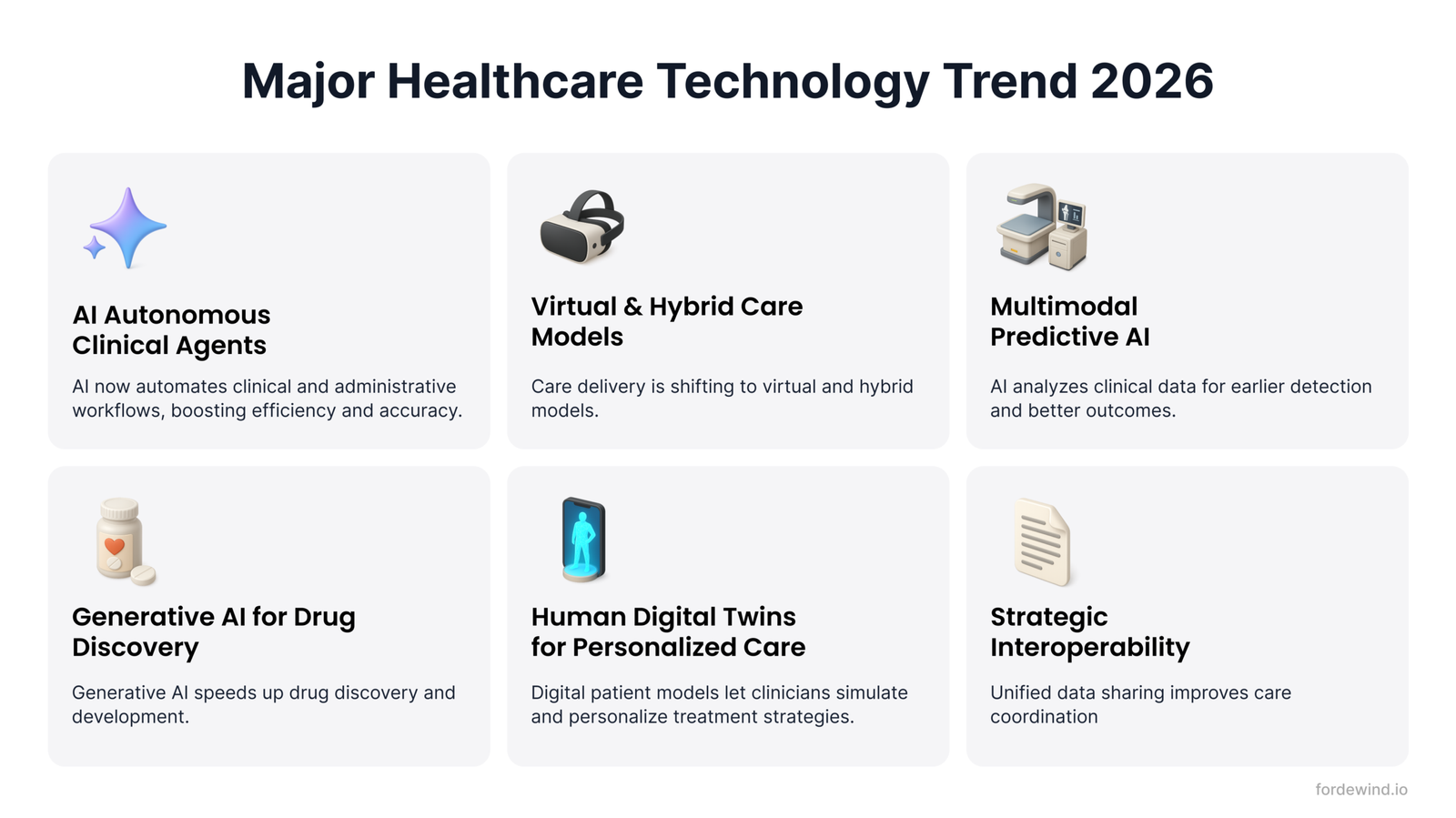
Here are the six pillars reshaping the industry this quarter:
1. The Rise of Autonomous Clinical Agents
We’ve graduated from basic chatbots to true Clinical Agents. These AI “copilots” now handle heavy-duty administrative and clinical triaging. By embedding directly into EHR systems, they aren’t just giving advice, they are executing workflows, reducing the burnout that has plagued our workforce for years.
2. Virtual & Hybrid Care Models
Virtual care isn’t a “backup” anymore. As Deloitte warned, the financial stakes are high, health systems failing to offer virtual models risk losing billions. Programs like Mayo Clinic’s Advanced Care at Home have proven the point: 0% in-program mortality and high efficiency. We’re seeing a definitive shift toward treating moderate-acuity patients in their living rooms, not hospital wards.
3. Multimodal Predictive Power
We no longer look at data in silos. Q1 has shown the massive impact of Multimodal AI – systems that cross-reference MRIs with genomic data and clinical notes in real-time. This isn’t just “faster” diagnostics; it’s a more accurate, predictive layer that catches risks like sepsis or clinical deterioration long before they become emergencies.
4. Generative AI for Drug Discovery
In drug discovery, the “decades and billions” model is breaking. Companies are now using GenAI to design molecules and, crucially, to create synthetic patient data. This allows us to simulate clinical trials safely and rapidly, bringing life-saving therapies to market at a fraction of the traditional cost.
5. Human Digital Twins for Personalized Care
The concept of the Human Digital Twin is now practical. By using real-time data from wearables, clinicians can simulate a treatment on a patient’s virtual replica before starting the real-world therapy. It’s the ultimate form of “measure twice, cut once” for personalized medicine.
Check and Explore Fordewind Healthcare Solutions’ development and integration of Healthcare IoT and wearable technology.
6. Strategic Interoperability
Building the Future of Connected Care Together
As we move through 2026, it is clear that the “hospital of the future” isn’t a building, it’s a connected ecosystem. At Fordewind.io, we move beyond simple connectivity to deliver the infrastructure that powers strategic interoperability and hybrid care models.
We don’t just provide hardware; we provide the data-driven foundation for AI autonomous clinical agents and human digital twins that are already saving lives and reducing provider burnout.
Ready to move from pilot to scale?
Whether you are looking to launch a “hospital-at-home” program or integrate multimodal predictive AI into your clinical workflow, let’s build a more resilient, personalized healthcare future together.
Contact Fordewind.io to explore our 2026 IoT roadmap and start your next project.