
✆ + 1-646-235-9076 ⏱ Mon - Fri: 24h/day
Livestock Monitoring: The Benefits of IoT-Enabled Smart Farming

A modern farmer no longer has to enter the barn every hour to make sure the livestock is fine. The smartphone itself notifies them: a cow’s temperature has risen, a sheep has strayed from the flock. All this data arrives in real time thanks to smart sensors, drones, and digital platforms. What seemed like science fiction yesterday is becoming today’s reality, transforming livestock farming worldwide.
Modern agriculture faces unprecedented challenges. By the middle of the 21st century, the Earth’s population will exceed 9 billion, with most people living in cities. This means agribusiness will have to produce far more food than ever before. This is especially true for livestock farming, which must not only increase productivity but also do so efficiently, sustainably, and with attention to animal welfare.
This is where smart farming comes into play. IoT makes it possible to transform an ordinary farm into a high-tech system where each animal is under constant “digital supervision.” The market for such solutions is growing at a rapid pace, and more and more farmers are choosing innovations that allow them to increase profitability while ensuring sustainable development.
Challenges in Modern Livestock Farming
The challenges in livestock farming today are significant. Demand for livestock products is growing alongside population growth and urbanization. Fewer people work in agriculture, as young people are moving to cities in large numbers, and the average age of farmers continues to rise. As a result, each farm worker is responsible for more animals, and there are not enough hands to provide constant supervision over large herds. More production must be achieved with fewer resources, requiring improved efficiency and higher levels of automation.
- Animal health. Animal health requires constant monitoring, but traditional observation methods are often ineffective. Difficulties with livestock frequently go unnoticed, as they are hard to detect by outward signs alone. Additionally, animal welfare is affected by stress factors such as heat. During the summer months, milk yields can drop by nearly half if comfortable conditions are not maintained. Without modern monitoring systems, farmers often react too late, leading to production and income losses.
- Efficiency and competitiveness. Traditional herd management methods – daily rounds, visual inspections, paper records – consume a lot of time and fail to provide a complete picture. In the global market, where product quality requirements are high, farmers are forced to seek new ways to optimize operations. Farms that do not adopt modern technologies quickly fall behind: their costs for feed, water, and veterinary care rise, while results remain lower. In contrast, smart systems help reduce losses, minimize risks, and improve farm performance.
In other words, the challenge is clear: how to feed more people with fewer resources while facing labor shortages and animal health issues? The answer lies in digital technologies, particularly IoT, which can make farms far more efficient.
IoT Solutions for Livestock Monitoring
The Internet of Things (IoT) in agriculture is the concept where everyday objects (devices) are equipped with sensors, connected to the internet, and able to collect and transmit data. In livestock farming, IoT means that every cow or sheep can literally be “online”: wearing sensors that constantly track its condition and automatically report important information to the farmer. Modern wearable devices for animals include smart collars, ear tags, and others. They measure key indicators such as body temperature, heart rate, activity level, step count, behavioral patterns (lying/moving), body position, and GPS location. At the same time, environmental sensors are installed on the farm – to monitor microclimate (temperature, humidity, ammonia levels), lighting, and the status of waterers and feeders. The data collected by sensors is transmitted through wireless networks to the cloud, where it is processed by software.
How does it work in practice? The components of a typical IoT livestock solution include:
- Animal-mounted sensors. Track vital signs and behavior. For example, a collar with an accelerometer and thermometer can detect that a cow is moving less and has a higher temperature – signs of potential illness.
- Data transmission network. Using wireless technologies (Wi-Fi, 3G/4G/5G cellular, specialized IoT protocols such as LoRaWAN or NB-IoT), data from sensors is sent to a gateway or directly to the internet. In remote pastures, energy-efficient long-range networks or satellite connections are used.
- Cloud platform and analytics. Information is centralized in a database, where applications and algorithms analyze it in real time.
- Applications. Farmers and veterinarians view monitoring results via mobile apps. On the smartphone screen, they can see a map with animal locations, graphs of temperature and activity, and alerts about abnormalities.
- Automated actions. The farm can respond automatically. If sensors detect overheating in the barn, fans or water sprayers are activated.
Key Benefits of IoT Livestock Monitoring:
- 24/7 monitoring and instant alerts. The system provides full-time control of animals. If a health issue or injury occurs, the farmer is immediately notified. Sensors can detect problems days earlier than a human, enabling timely veterinary intervention. Continuous monitoring is also useful for remote pastures, reducing the need for frequent inspections.
- Improved health and welfare. IoT devices act like fitness trackers for livestock: tracking parameters, detecting problems early, and enabling fast response. The data also helps create optimal living conditions – comfortable microclimate and reduced stress.
- Precision feeding and optimized diets. Sensors show how much feed and water each animal consumes. Smart feeders weigh the food and deliver individual portions, avoiding overfeeding or underfeeding. This saves up to 10% of feed, ensures a balanced diet, and reduces environmental impact.
- Lower costs and better performance. Automating routine processes reduces labor and transport expenses. With monitoring, farmers can remotely manage dozens of barns.
- Transparency and traceability. Digital records allow health status and product origin to be tracked down to specific batches. This increases consumer trust and simplifies regulatory compliance.
Despite the advantages, farmers often worry about high upfront costs and connectivity issues in rural areas. However, sensor prices are steadily decreasing, and modular systems with flexible payment models are emerging. For areas with poor internet, solutions like LoRaWAN, satellite communication, or local edge computing are applied. Data security is also safeguarded – modern platforms encrypt information. As a result, IoT solutions are becoming more accessible and easier to implement, and farmers are increasingly convinced of their benefits.
Examples of Successful Implementation
Let’s look at several real-world cases that demonstrate the effectiveness of IoT in livestock farming around the globe.
- Ireland (and 40+ countries worldwide). The Moocall sensor saves calves. One of the most popular inventions by Irish farmers is the smart Moocall sensor. The device is attached to a cow and measures the frequency and intensity of movements. When labor begins, Moocall recognizes the characteristic patterns and sends an SMS notification to the farmer. This allows timely assistance to the animal, especially in cases of complicated births. As a result, many calves and cows have been saved, and farmers no longer need to stay up for night watch in the barn. Since its launch in 2014, Moocall has spread to more than 40 countries, becoming one of the most successful AgTech products.
- USA and Australia. GPS trackers and drones on pastures. On large ranches with thousands of cattle grazing across hundreds of hectares, IoT technologies have become indispensable. Cows are equipped with GPS collars or ear tags with trackers, allowing real-time monitoring of each animal’s location. This simplifies finding lost livestock, prevents theft, and improves grazing control. Some farms use drones with cameras and thermal imaging to patrol pastures: the drones automatically count animals and identify strays. In Australia, systems are being tested where drones fly over pastures every evening and compare the cattle count against a database. If discrepancies are found, the farmer receives an instant alert. Another innovation is “virtual fencing”: cows wear collars that emit a sound or light vibration when the animal approaches the grazing boundary. This keeps the herd within electronic borders without physical fences. Trials have shown that animals quickly learn to respond to signals and stay within the set limits.
- Europe. Welfare and quality control. In EU countries, strict animal welfare regulations are in place, and IoT is widely used to support compliance. In Denmark, for example, pig farms use acoustic sensors that “listen” for coughing, signaling possible respiratory infections. In the Netherlands, nearly every cow has an electronic chip or collar integrated with farm management software. This simplifies record-keeping, milk certification, and treatment monitoring. Some dairy farms use automated sorting systems: when a cow enters the milking parlor, the system scans its chip and can direct it to a special area for inspection or additional feeding. In Switzerland and Germany, “farm in a smartphone” platforms are gaining popularity, consolidating all data – from feed and silos to finances and animal health. In the Netherlands, experiments are even underway with robotic shepherds – mobile robots that move across pastures and help guide cows to milking.
As we can see, IoT solutions are being successfully applied both on small family farms and on giant agribusinesses. In many cases, technology adoption is supported at the state level through grants and subsidy programs. Thus, “smart livestock farming” is no longer futurism, but a modern global practice.
Smart Farm Architecture
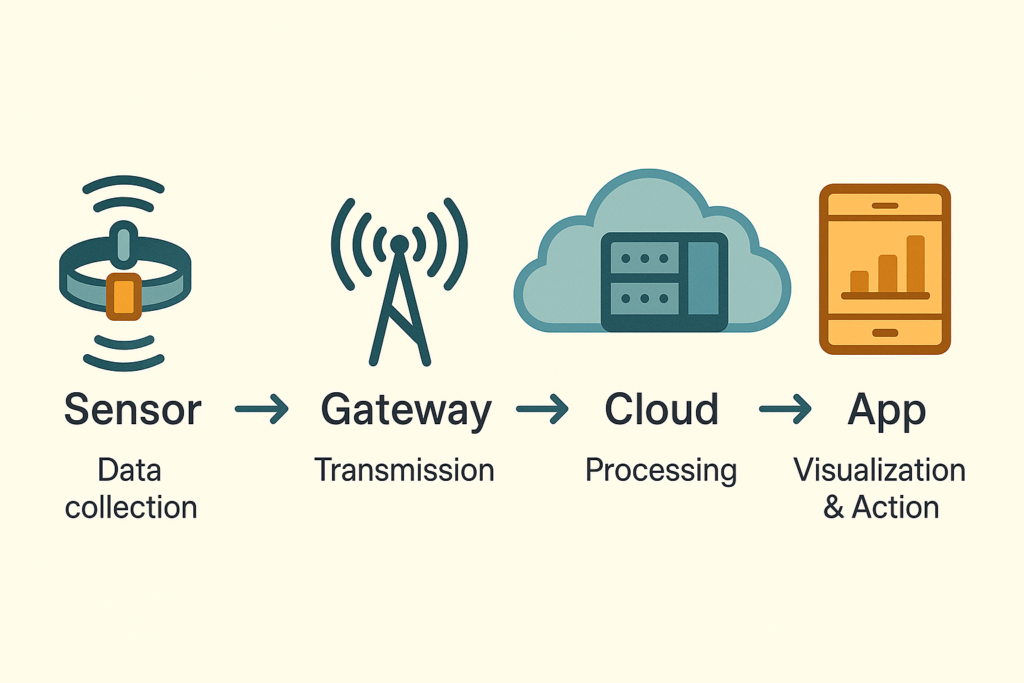
Source: Image generated via ChatGPT 5 by Volodymyr Kazakov
As shown in the diagram above, a typical IoT infrastructure for a livestock farm has a multi-layered structure.
First layer – field layer (data collection devices)
This includes all physical sensors and gadgets: collars, biochips, cameras, weather stations, feeder sensors, and more. They continuously record parameters and may be connected into a local network (e.g., a wireless sensor network). Modern devices use energy-efficient microcontrollers capable of operating for months on batteries, transmitting data periodically to save power. Often, data is sent in small packets via LPWAN (Low Power Wide Area Network) technologies such as LoRaWAN, Sigfox, or NB-IoT, designed for long-distance telemetry with minimal energy consumption. If the farm has Wi-Fi or cellular coverage, devices can also use those.
Second layer – network layer (gateways and communication)
Not all small sensors can connect directly to the internet, especially those using short-range protocols (Bluetooth, Zigbee). That’s why farms deploy one or more gateways – intermediate devices that collect data from nearby sensors and forward it to external networks. A gateway can be a dedicated base (e.g., a receiver that collects signals from all collars within a 5 km radius) or even a regular smartphone/tablet with an app that polls sensors via Bluetooth. The gateway’s main task is to convert local protocol data into internet protocols and transmit it to a server. Depending on the setup, data may travel via wired internet (cable, fiber), cellular networks (SIM card in the gateway), or satellite to reach the cloud. At this level, connection reliability is critical: systems employ redundancy (e.g., auto-switching from Wi-Fi to 4G if Wi-Fi fails), backup power (batteries in gateways), and traffic encryption for security. Since many farms are remote, private initiatives are common – for example, a farm may build a radio tower to cover nearby farms with signal, creating a shared IoT network.
Third layer – data processing center (servers, cloud services)
This is where all farm data flows. In the past, this meant a computer in the farmer’s office, but today it is often a provider’s cloud service or a private server. Applications run on top of the data: some monitor streams in real time to detect events (e.g., alerts), while others generate analytics, reports, and predictive models. Machine learning is widely used: systems accumulate large datasets for each animal and gradually improve anomaly detection. For example, an algorithm trained on thousands of cows can predict health issues based on subtle behavioral changes that human observation would miss. While the final decision always rests with the farmer, such insights are highly valuable. Cloud systems also integrate with other services: automatically ordering medicine or calling a vet via API, sending reports to government registries, or updating farm accounting software. Scalability is another advantage: major cloud platforms (e.g., AWS, Azure) can process streams from thousands of devices, scaling resources as the farm grows.
Fourth layer – application layer (user interface and management)
This is what the farmer or farm manager sees and interacts with. The information collected and analyzed earlier is presented in a clear form: dashboards, charts, alerts, and recommendations. For example, a veterinarian’s dashboard shows all cows with their temperature and heart rate; those with suspected issues are highlighted in red. In the feeding module, a manager can view silage stock levels and per-animal feed consumption trends; if cows are under-consuming mixed rations, adjustments can be made to the mixer or feed quality checked. System management is also handled here: setting alarm thresholds, grouping animals under different regimes, etc. Interfaces are typically multi-platform: accessible via office computers or smartphones in the field. This gives farmers unique flexibility – the ability to manage farms remotely. Many recall how, just a decade ago, taking a vacation for a few days was a luxury, as the farm could not run without them. With IoT systems, owners can travel abroad and still monitor their farm, receiving alerts and giving instructions to staff or calling a local specialist if needed.
The architecture of a smart farm is modular and flexible. Depending on needs, different components can be combined. Yet the principle remains the same: data → transmission → analysis → action. Ultimately, this architecture is designed to make livestock management more evidence-based, automated, and precise.
Fordewind: Experts in IoT Solutions for Business and Agriculture
In a world where the Internet of Things is becoming the backbone of digital transformation, it is essential to have a partner who combines deep technical expertise with practical experience. Fordewind is a team with years of proven success in IoT, creating solutions across various industries: from agriculture to manufacturing, transportation, and smart homes.
The company covers the full IoT development cycle:
- Hardware & Firmware – design of sensors, controllers, and embedded software.
- Software & Cloud – server-side solutions, cloud integration, and big data analytics.
- Mobile & Web – intuitive applications and web interfaces.
- AI & Analytics – machine learning algorithms for prediction and optimization.
Thanks to this holistic approach, Fordewind delivers not just standalone devices but entire ecosystems that function as a single organism. Whether it’s livestock monitoring, greenhouse automation, or production process control, every solution is tailored to the client’s specific needs.
By working with Fordewind, businesses gain:
- Reliability – technologies tested and proven in real-world conditions.
- Flexibility – step-by-step project implementation, from MVP to a fully scalable system.
- Value – reduced costs, new efficiency streams, and opportunities for business growth.
Today, Fordewind is implementing projects in many countries around the world, demonstrating that IoT is not the future but a real tool that is already helping companies transform the way they work, reduce risks, and unlock new opportunities.
Conclusion
IoT technologies have already proven their ability to radically transform livestock farming. They address key challenges faced by farmers: helping detect animal health issues early, avoid unnecessary spending on feed and medicine, automate routine processes, and provide transparent real-time monitoring. This means fewer losses, healthier herds, better animal care, and products consumers can trust.
For farmers, this is not only an opportunity to boost efficiency but also to strengthen their position in the global market. Getting started can be simple: install a few sensors to track animal activity or monitor barn microclimate, test initial solutions, and see results. Even such small steps can reveal weak points in farm management and enable more data-driven decisions.
It is important not to stand aside and to choose reliable partners. Fordewind has deep expertise in IoT and supports implementations of any scale – from pilot sensor projects to full-scale cloud platforms with mobile apps and analytics. This means farmers receive not just technology, but a complete solution that truly works and delivers measurable results.
Smart farming with IoT is not a trend but a necessity. In a world where more high-quality food must be produced with fewer resources, digital technologies are becoming indispensable tools. The sooner you start digital transformation, the sooner you’ll reap its benefits.
Don’t postpone change until tomorrow. Begin integrating IoT solutions into your farm today – and watch your business rise to a new level of efficiency and profitability.