
✆ + 1-646-235-9076 ⏱ Mon - Fri: 24h/day
Battery-Powered IoT: How to Stretch Lifetime from Months to Years

The IoT market is scaling fast, more devices are being deployed where there is no mains power, or where running a cable is not worth the cost. GSMA Intelligence projects that the global IoT market could reach 38.7 billion connections by 2030, the share of enterprise connections is still growing.
City infrastructure is under more pressure too. The UN notes that in 2018 about 55% of the world’s population lived in cities, by 2050 that share could reach 68%. This drives demand for sensors in water, energy, environment, transport, and public safety. Many of these sensors are best designed as autonomous devices.
Battery-powered IoT follows a simple rule. The larger the fleet and the harder it is to reach devices, the more expensive battery replacements become. Technician visits, service downtime, and reputation damage add up fast. That is why 5-10 years of autonomy has become a common requirement for many IoT classes, especially metering and city sensors.
Why battery-powered IoT autonomy becomes a bottleneck
The problem is that an IoT device does not use energy evenly. It sleeps most of the time, the main cost comes from short spikes during radio activity, sensing, and compute. In battery devices, transmit or receive peaks can reach tens of mA, that quickly exposes weaknesses in the power design.
Battery limits are often underestimated during prototyping. For example, a CR2032 coin cell has a nominal capacity of around 225 mAh and a recommended continuous discharge of 0.2 mA. It works well for long sleep and rare events, it struggles with frequent or long radio sessions.
Autonomy depends on connectivity conditions too. With weak coverage, time on air goes up, retries increase, transmit power can rise, battery life drops faster. In cellular IoT, settings such as PSM and eDRX can shift the balance between energy use and latency, especially in difficult radio conditions.
A separate risk is patterns that intentionally speed up discharge. Repeated reconnects or triggers that force frequent responses can drain a battery even without a full device compromise.
Finally, autonomy forecasts often diverge from reality because of methodology. In the lab it is easy to compute average current. In the field, link quality, temperature, battery aging, and real traffic patterns all matter. That is why lifetime estimates should be validated with measurements and tests under conditions close to deployment.
Solutions that turn months into years
Moving from months to years almost always comes from a combined set of choices across four layers. Data policy, hardware, firmware with radio tuning, measurement and quality control.
Start with an energy budget as a product requirement
Multi-year autonomy usually means average current in the single to tens of microamps range, depending on the battery type. Add margin for temperature, aging, and real cell behavior so the estimate does not fall apart in the field.
In firmware, the main lever is sleep and duty cycling
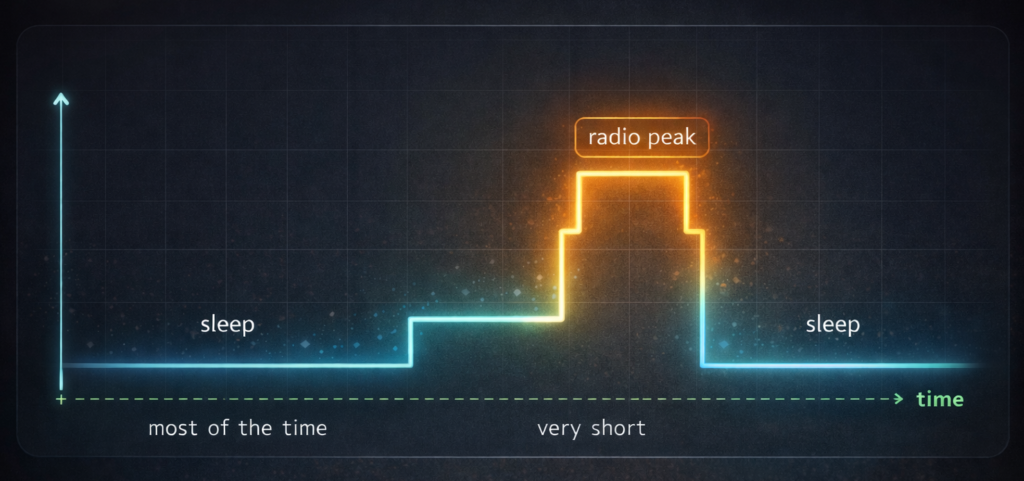
Why average current is more important than peak current
Maximize deep sleep, keep active phases as short as possible. Batch data and transmit less often. Use event-driven logic instead of constant polling. Keep radio sessions short, avoid long tails of active time. Peak events define requirements for the power source and buffers, sleep defines the average current. For BLE and mesh systems, intervals matter. Changing advertising or exchange parameters can noticeably reduce average consumption.
Pick connectivity based on the data profile
For large sensor fleets with small payloads, LPWAN options often fit because they behave better in battery mode. For cellular IoT, power saving modes such as PSM and eDRX are key. They reduce how often the device listens to the network and let it sleep longer. In real projects, lifetime can swing sharply based on timers and send cadence, so these parameters should be designed with the same care as the hardware.
Power design needs to handle peaks, not just capacity
For 10 plus years, teams often move from coin cells to primary lithium packs with low self-discharge. Coin cells may not handle radio peak currents, so buffers matter. Capacitors, supercapacitors, or power management that smooths voltage droop can help.
Make measurement part of the process, not a final checkpoint. With long sleep cycles, average current is hard to measure with basic tools. It is better to tie measurements to radio and power events and track charge consumed. This makes it easier to catch unnecessary wakeups, long radio tails, and timer bugs that can cost you years of autonomy.
Real deployment examples
These cases from different countries point to one shared principle. Multi-year autonomy shows up when the system is designed for real conditions, not for a lab profile. Data policy, radio behavior, power design, and operations need to work as one.
India, Amritsar, smart parking and an install-and-forget approach
In Amritsar, a LoRaWAN proof of concept was deployed. The team installed six parking sensors, rolled out network infrastructure, and sent data into an analytics platform and a mobile app. After two months of data collection, they reported ROI of about 10 times the solution cost. This shows how energy efficiency turns into city economics. Fewer site visits, less manual checking, better enforcement and control.
The technical logic is simple. The sensor sleeps most of the time, wakes on an event, sends a short status message, then goes back to sleep. One field detail matters here. Before launch, the team ran a radio survey of the locations to minimize retries and avoid extra time on air.
China, water meters and a measurement-first mindset
A water meter modernization project exposed unexpected energy use during design. The team broke power costs down by phases. Sleep, sensing, processing, radio session, retries. They made decisions based on real profiles instead of a lab average current number. After profiling and optimization, they reported a projected battery life above 10 years.
France and global Sigfox deployments
With Sigfox, autonomy is partly enforced by the channel model. Payloads are very short and message counts are limited. This forces rare and simple telemetry, which naturally saves battery. The network is positioned as global with presence in more than 70 countries and coverage of over 1 billion people through local operators. The target autonomy is at least 10 years for data collection nodes. Energy efficiency often comes from a disciplined data policy, not only from battery selection.
Autonomy measured in years comes from a service built around short and infrequent communications. It also depends on reducing retries through radio planning, handling power peaks, and validating estimates with measurements under field-like conditions. This lowers OPEX and lets fleets scale without constant truck rolls.
Architecture and technical frame for an autonomous device
You can use this section as a template for most battery devices, whether it is BLE, LoRaWAN, or NB-IoT. A multi-year lifetime rarely comes from one trick. It comes from power design, firmware, radio profile, and field control working together.
Device architecture
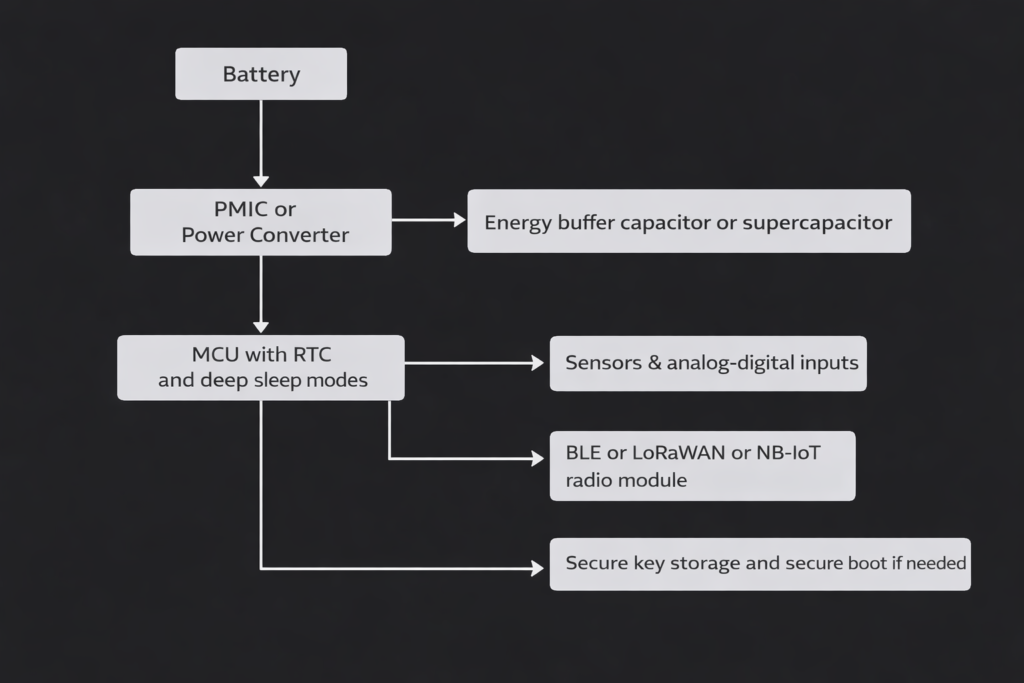
The battery powers the node through a PMIC or a converter. Next is an MCU with an RTC and deep sleep modes. Sensors and a radio module connect to it. If higher security is needed, add secure boot and protected key storage. One critical element is an energy buffer. It helps the device survive short current peaks during transmissions and reduces the risk of voltage sag, especially with small batteries.
System architecture from device to service
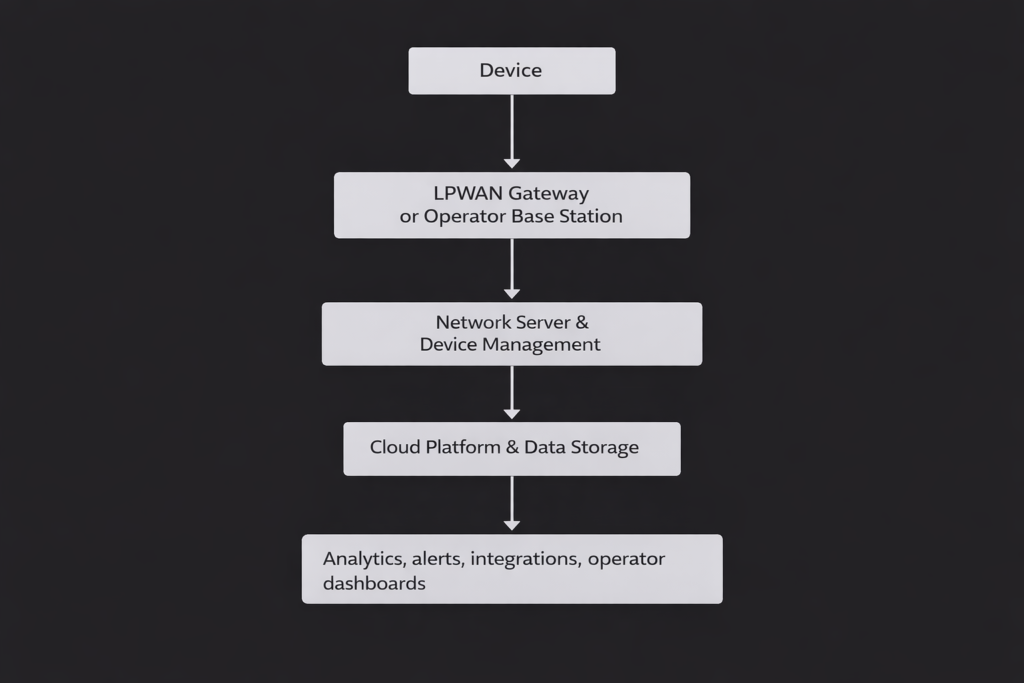
The device sends data into the network infrastructure. Then device management components handle onboarding and telemetry delivery into the cloud. From there, data flows into analytics, alerts, integrations, and operator dashboards. LoRaWAN typically uses a star topology where most complexity sits in gateways and the server side, the end device can sleep almost all the time. In NB-IoT and LTE-M, autonomy depends heavily on network sleep behavior and how often the modem becomes reachable for downlink.
What usually drives the biggest autonomy gains
- Radio profile and send cadence. In BLE, energy use is very sensitive to advertising intervals and connection parameters. Changing intervals directly shifts the tradeoff between discovery speed and battery life. In NB-IoT, the big difference comes from how long the modem stays reachable for downlink, how often it runs network procedures, and which sleep timers are used. In LoRaWAN, autonomy depends on message frequency, radio settings, retries, and link quality. Poor placement or obstacles often force higher transmit power and more time on air.
- Current peaks, buffering, and voltage sag protection. In many devices, autonomy collapses not because of average current, but because voltage sags during peaks. That triggers resets, retries, and hidden energy loss that burns through the budget fast. An energy buffer and a proper PMIC reduce this effect and stabilize operation under short bursts.
- Battery choice for temperature and target lifetime. When the target is measured in decades, self-discharge and cold behavior become decisive. Long-life designs often use chemistries with low self-discharge. Coin cells are convenient for compact products, but they have limits on continuous current and are sensitive to high peaks, so they need good power design and short radio sessions.
- Protect sleep modes from unnecessary activity. In long deployments, you need to prevent external events from keeping the device awake without a real need. In practice this means rate limits on responses, control over repeated connections, limits on wake-up commands, and a predictable retry policy. This protects battery budget and keeps device behavior stable in the field.
A small energy budget example to sanity check orders of magnitude
This is an illustrative example that shows how rare transmissions can turn into years of autonomy. The peak numbers match the typical order of magnitude for coin cells and radio bursts. The microamp baseline matches deep sleep levels you can reach on low-power platforms between events.
Model parameters
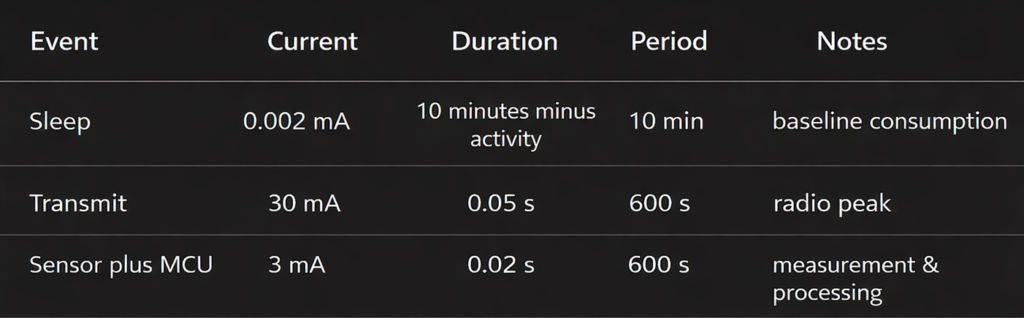
- Sleep current is 2 µA most of the time.
- A peak current of 30 mA for 50 ms happens once every 10 minutes.
- Extra MCU and sensor activity draws 3 mA for 20 ms once every 10 minutes.
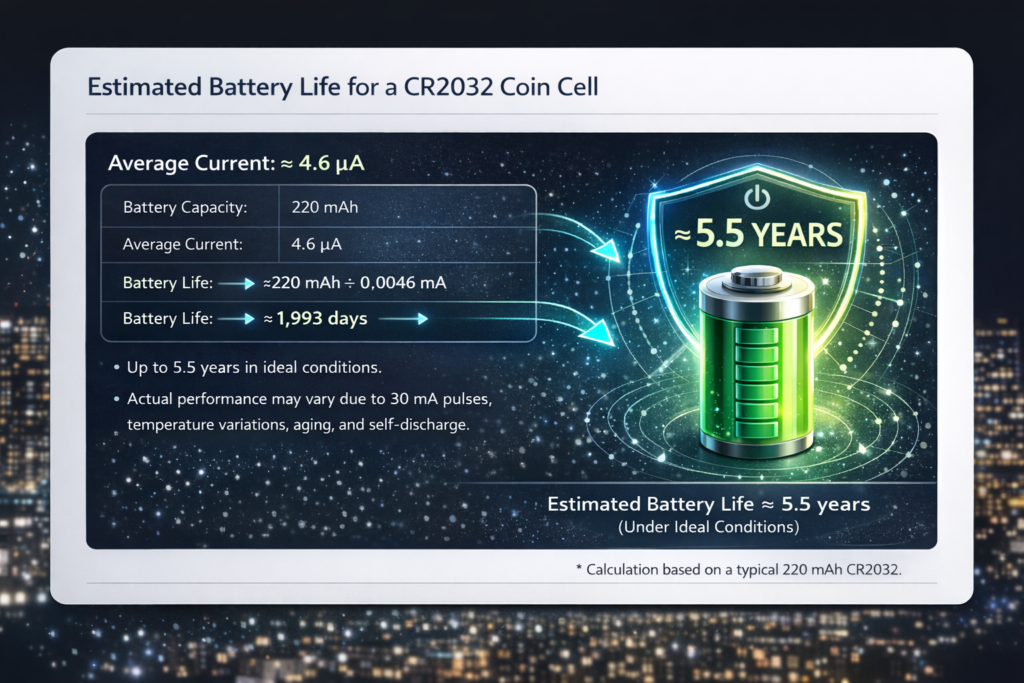
In this model, the biggest levers are reducing how often events happen, shortening time on air, removing unnecessary retries, and pushing sleep current down to real microamp levels or lower. That is what long-life systems do, and it is why some deployments run for years.
Conclusions
Autonomous IoT is limited less by the battery itself and more by scale. When sensors sit in hard-to-reach places, replacing power cells quickly turns into an expensive and slow service process.
To move from months to years, you need a system approach. Cut average current. Make transmissions rare and short. Match connectivity to the data profile. Choose battery chemistry that fits temperature and target life. Stabilize peaks with buffering and power management. Then validate everything with measurements, not with paper estimates.
The impact is easy to track. Fewer site visits and battery swaps reduce OPEX. More stable power gives cleaner data with fewer resets. Repeatable validation makes scaling across countries more predictable.
The practical plan is short too. Define the energy budget as a product requirement, validate it with event-based measurements. Run a pilot in two radio conditions, one good and one harsh. Then protect the battery budget in device logic through trigger rate limits, retry control, and short radio sessions, so autonomy does not break from noise, errors, or intentional load.
Fordewind can be a technical partner in the shift from months to years of battery life. The team helps turn an energy budget into clear device requirements, validate them with measurements in real conditions, choose the right connectivity stack and power management approach, and bring the solution to a repeatable production process. As a result, autonomy stops being lucky on a single prototype. It becomes a controlled outcome that scales reliably.