
✆ + 1-646-235-9076 ⏱ Mon - Fri: 24h/day
Matter Cameras Without Storage or AI Events

Matter crossed an important line when the Connectivity Standards Alliance released Matter 1.5 with official camera and video doorbell support. The update includes live video and audio, WebRTC based streaming, pan tilt zoom, privacy zones, detection zones, and flexible recording paths to local or cloud storage.Matter 1.5.1 then improved camera performance with multi stream delivery, HEIC snapshots, and support for HLS and DASH upload workflows.
That progress is important because cameras were one of the most visible missing categories in Matter. A light bulb, plug, or thermostat is easy to model as a device. A camera is different. The real value is not only in turning it on. It is in finding out what happened, understanding whether it mattered, and keeping the right evidence available later.
This is why the business question is more interesting than the protocol question. When Matter makes cameras easier to connect across ecosystems, who captures the valuable parts of the experience after connection, the platform or the device maker?
What Matter brings and what it does not define
Matter brings a shared way to onboard, identify, control, and stream from a camera. It can reduce custom integration work and give buyers a more portable baseline experience. For device teams, this is a meaningful engineering win. It makes the camera less dependent on one proprietary smart home path.
Matter does not, by itself, decide where video is stored, how long clips are kept, which AI events appear in the app, which features require a subscription, or how privacy is explained to the user. Independent coverage of Matter 1.5 made the same point. Camera support can enable storage paths, but the actual storage service and AI event layer remain platform or vendor decisions.
Diagram. The useful camera stack shows that interoperability is only one layer.
Where is value created in a camera experience
A camera creates value across a chain of layers. The device maker usually controls the image sensor, lens, low light quality, firmware reliability, physical privacy features, and edge compute. Matter helps with the connection and stream. Then the platform, vendor cloud, or local edge system may process, store, classify, present, and monetize the footage.
The most valuable layers are usually above the protocol. Users return to the app for timelines, smart alerts, clip search, automation, sharing, and peace of mind. Those are not passive device features. They are ongoing services. They create customer lock in, recurring revenue, and data driven product improvement.
That means a camera can become a sensor that feeds someone else’s business model. If the platform owns event history, AI labels, automation triggers, and the subscription package, the platform owns the customer relationship. The device maker still sells hardware, but it may lose the most profitable layer of the product.
Why storage is the first value layer
Most people do not buy cameras only to watch live video. They buy cameras to answer a question later. Who came to the door. Was the package delivered. What triggered the alarm. What happened in the garage overnight. This makes clip storage and retention one of the first places where value is captured.
Google Home Premium is a useful example. Google describes paid plans that add longer event history and, on eligible wired cameras, continuous video history. Apple takes a different route with HomeKit Secure Video, where video is analyzed through a home hub and stored in iCloud as part of an iCloud Plus plan. In both cases, the valuable timeline lives in the platform experience, not simply inside the camera.
A device maker can defend value if it offers local storage, NAS support, RTSP access, local backup, clear export tools, or a strong vendor app. Without those features, the product risks becoming interchangeable hardware connected to a more valuable platform service.
Why AI events decide who owns the user
Motion detection is not enough anymore. Buyers expect useful events. Person detected. Package delivered. Animal in the yard. Vehicle in the driveway. Familiar face at the door. Sound detected. These labels decide whether notifications feel helpful or noisy.
Google Home camera automations show how platform specific this layer can be. Some camera event starters depend on Nest cameras set up in Google Home, and familiar face features can depend on Google Home Premium. Amazon also exposes camera intelligence through its own smart home security and SmartVision interfaces. These are not generic Matter benefits. They are platform value layers.
Device makers can still win when AI runs locally and remains useful outside the platform. Aqara’s Camera Hub G5 Pro is an example of this strategy. Its product pages emphasize local AI, encrypted local storage, NAS support, RTSP streaming, and multi ecosystem compatibility. In that model, Matter improves reach while the device keeps differentiated intelligence.
Platform led, device led, or hybrid
A platform led model captures value through the app, cloud storage, event history, smart alerts, automations, and subscriptions. Google Home, Apple Home, SmartThings, and Alexa all show different versions of this strategy. The platform wants the camera to become part of a larger home experience, not a standalone device.
A device led model captures value through hardware quality, local intelligence, privacy controls, local recording, and a vendor experience that remains useful even when platform support is uneven. This path can protect margin and brand value, but it requires more product investment. The device maker cannot rely on the platform to make the product feel complete.
The likely winner is hybrid. Matter can handle onboarding and baseline interoperability. Platforms can provide distribution, timelines, and automations. Device makers can keep value through privacy, local AI, reliability, and differentiated hardware. The question is not which side wins everything. The question is who owns the layers users care about daily.
| Model | Where value sits | Who owns storage | Who owns AI events | Likely winner |
| Platform led | App, timeline, automations, subscription | Platform cloud | Platform cloud or platform services | Platform |
| Device led | Hardware, local storage, edge AI, vendor app | Device, NAS, vendor cloud | On device or vendor app | Device maker |
| Hybrid | Matter onboarding plus differentiated upper layers | Shared local and cloud paths | Split between edge and platform | Shared value |
What should product teams build now
Product leaders should not treat Matter camera support as the full roadmap. The standard solves part of interoperability, but the commercial strategy must define the upper layers. Before launch, teams should decide where clips live, which AI events exist, what is free, what is paid, what works locally, and what happens if a target platform does not yet expose the expected camera features.
A practical product plan should include a storage matrix, an event taxonomy, a privacy model, and a platform validation plan. The storage matrix should cover cloud, local, NAS, export, deletion, retention, and offline behavior. The event taxonomy should separate baseline events from premium events. The privacy model should make local processing, encryption, user permissions, and data retention visible.
The platform validation plan matters because rollout is still uneven. SmartThings publicly announced Matter camera support and platform features such as live streaming, clip storage, event history, motion zones, and privacy zones. Apple, Amazon, and Google publish separate Matter support pages and camera integration materials, but public support differs by ecosystem and product path. A real product must be tested inside the ecosystems buyers actually use.
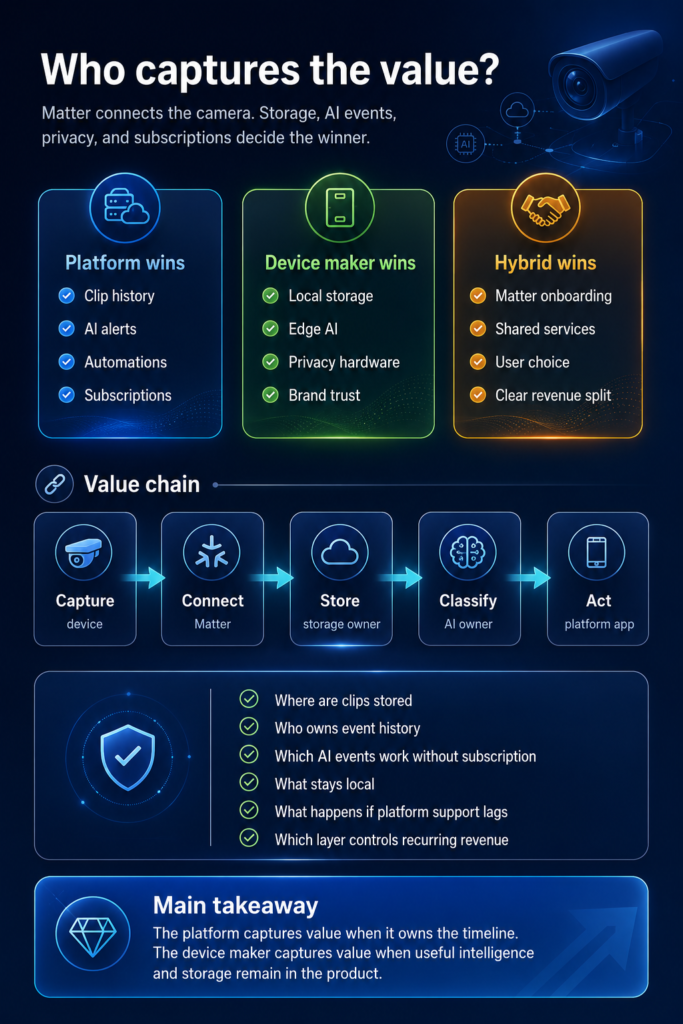
Full infographic. Who captures the value in a Matter camera product.
Conclusion
For camera products, the best architecture is honest about value capture. If the platform should own the timeline, design for clean integration and revenue sharing. If the device maker should own more value, invest in local intelligence, local storage, and a vendor experience that remains useful beyond basic Matter connectivity.
Matter makes cameras easier to connect, but it does not make cameras economically equal. The layers above connectivity still decide who captures value. Storage creates the timeline. AI events create useful alerts. Privacy creates trust. Subscriptions create recurring revenue. The owner of those layers owns the customer relationship.
For device makers, Matter is not a reason to give up differentiation. For platforms, Matter is a chance to pull cameras into a larger service experience. For users, the best future is hybrid, with open onboarding, reliable hardware, clear privacy, useful local capabilities, and transparent services.