
✆ + 1-646-235-9076 ⏱ Mon - Fri: 24h/day
In Agri-IoT, the Number One Failure Is Not Sensor Accuracy, It’s Service

The most common Agri-IoT disappointment is not that sensors are scientifically useless. It is that they are difficult to keep alive, connected, clean, calibrated, and physically protected during a real farm season. Once a node stops posting, runs out of battery, loses radio range behind a crop canopy, freezes, floods, gets chewed by rodents, or needs extraction before harvest, its nominal accuracy no longer matters.
This article investigates why the service model should be treated as a core part of Agri-IoT architecture. The key lesson for farms, vendors, and integrators is simple: sensor accuracy creates potential value, but serviceability converts that potential into usable seasonal data.
Why the failure is operational
In controlled conditions, many agricultural sensors can perform well enough for irrigation, climate, soil, livestock, or field monitoring decisions. The problem starts when those sensors leave the lab and enter a field where water, mud, frost, crop growth, machines, animals, and weak rural networks become part of the system.
A soil probe may be accurate when installed correctly, but wrong when it loses soil contact. A weather station may be reliable until its rain gauge clogs or a cable corrodes. A gateway may work in spring and fail in summer when crop canopy changes radio propagation. A dashboard may look modern while hiding the fact that half the network has not uploaded since yesterday.
The real KPI is data availability during decision windows
Farm decisions are seasonal and time sensitive. Frost warnings matter at night. Irrigation decisions matter during dry periods. Disease risk models matter when crop and weather conditions align. If the device is offline during those windows, the farm loses operational value even if the sensor had good lab accuracy.
That is why Agri-IoT buyers should evaluate service metrics beside measurement specs. Battery replacement, last-sync visibility, local buffering, field swap time, cable protection, antenna placement, winterization, and spare inventory belong in the same conversation as accuracy, resolution, and sampling frequency.
The heatmap below translates those service risks into a practical decision tool. The horizontal axis shows how strongly a failure affects project success, while the vertical axis shows how often the issue appears in the field. The most dangerous problems are not always the most technical ones. They are the ones that happen often, block access to data, and require a field visit at the worst possible time.
Battery depletion, connectivity dropouts, hard to access devices, replacement delays, and seasonality downtime sit in the high risk area because they can stop the system during irrigation, frost, or disease risk windows. Sensor accuracy appears lower in the chart not because accuracy is unimportant, but because an accurate sensor creates no value when the node is offline, buried in mud, disconnected, frozen, or waiting for replacement.
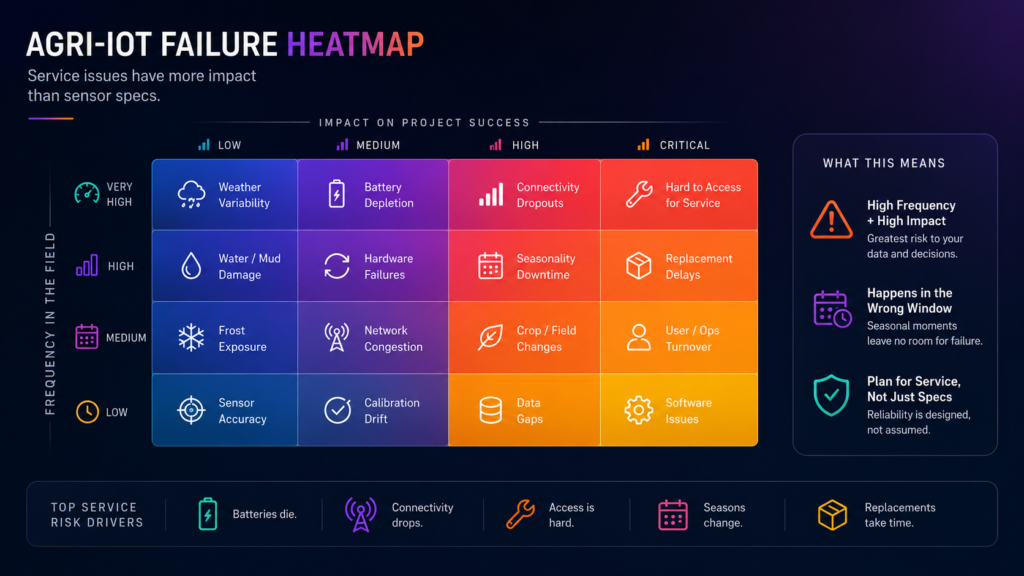
Figure 1. Service failure heatmap. Problems that force field visits during crop-critical periods carry the highest risk.
The highest risk Agri-IoT failures are the ones that combine operational impact with field frequency. A sensor accuracy problem can be corrected through calibration, but a power, connectivity, or access problem can remove the whole device from the decision loop. That is why serviceability, remote diagnostics, and replacement planning should be treated as core product features, not after sales support.
What fails first in real deployments
The table below is a practical service view. It does not claim universal vendor failure rates. It translates common public failure mechanisms into operational risks that procurement and engineering teams can manage.
| Failure mode | What usually causes it | Why it hurts | Service design response |
| Battery and power | Undersized batteries, low sunshine, high reporting rate, weak signal, poor solar placement | Nodes disappear during irrigation, frost, or disease windows | Expose battery health, design field swaps, validate worst month power budget |
| Connectivity | Weak cellular coverage, buried antennas, crop canopy, gateway overload, rural backhaul gaps | The dashboard shows silence instead of crop reality | Run RF surveys, monitor RSSI, add local buffering and gateway redundancy |
| Mud, water, frost | Ingress, condensation, freezing soil, flooded fields, dirty connectors | Hardware survives on paper but fails seasonally | Use correct enclosure design, cable glands, winterization and extraction SOPs |
| Cabling and physical damage | Rodents, machinery, bad splices, pulled wires, exposed connectors | Faults are hard to diagnose without health telemetry | Protect cables, standardize spares, make connectors replaceable |
| Cleaning and fouling | Dust, algae, sediment, detritus, insects, clogged rain gauges | Data drifts slowly and may look believable but wrong | Define cleaning cadence and sensor health checks |
| Seasonal operations | Planting, weeding, harvest, tillage, reinstall, storage | Service work arrives exactly when labor is already constrained | Plan lifecycle tasks before the season and assign ownership |
Case example 1. Power assumptions fail faster than sensors
Field studies on wireless sensor networks in agriculture show that gateway and node batteries can become the limiting factor. When a gateway dies at night or a coordinator battery depletes after rainy, low-sun periods, the network fails even if the sensing elements are still healthy. This is why power budgeting must be tested against real duty cycle, radio quality, and seasonal weather.
Case example 2. Crops change the network
A radio link that works on a bare field can weaken after crop growth. This turns connectivity into a seasonal variable. For Agri-IoT, RF planning should include expected canopy height and worst-case field conditions, not just a quick installation test.
Case example 3. Vendor support documents reveal the service workload
Commercial installation and maintenance guides often mention charging, antenna extension, battery thresholds, cleaning, sensor extraction, cable replacement, and winterization. These are not side notes. They describe the operating model required to keep the product useful.
What is the service lifecycle
The service lifecycle shows that Agri-IoT reliability is not a one-time installation task. It is a recurring operating loop. A sensor must be planned for the right field conditions, installed correctly, monitored remotely, maintained during the season, and replaced or upgraded before it becomes a point of failure.
This is especially important because farm decisions happen in short windows. A device that works well in June may fail in August because the battery is weaker, crops are taller, mud covers access points, or connectivity changes after weather conditions shift. The lifecycle view helps teams move from reactive support to planned service.
Instead of asking only, “How accurate is the sensor?” buyers should also ask, “How will we keep this sensor alive for the whole season?”
Figure 2. Service lifecycle flow. A deployment needs an operating loop, not only an installation event.
A reliable Agri-IoT deployment is a loop, not a launch event. Planning, installation, monitoring, maintenance, and replacement all protect data availability during the moments when farmers actually need the data. The stronger this lifecycle is, the lower the risk of downtime, emergency field visits, and missed decisions.
How to design for service instead of surprise
For device makers
- Design for field service before optimizing another decimal point of accuracy.
- Use replaceable batteries or accessible charging paths where possible.
- Expose battery, RSSI, last sync, temperature, enclosure state, and sensor health metrics.
- Make cables, antennas, seals, and sensor heads replaceable without full device replacement.
- Provide clear winterization, cleaning, and seasonal storage procedures.
For integrators
- Run a pre-season power and RF survey in representative field conditions.
- Design gateway topology for the real field, not for the demo plot.
- Create a spare parts kit and a service calendar before installation.
- Use health dashboards that separate sensor failure, link failure, and power failure.
- Document who owns each field touch.
For farms and buyers
- Ask what service actions are required over one full season.
- Prefer systems with clear battery state, last upload time, and alerts.
- Insist on a replacement plan for critical nodes before the season starts.
- Check whether data buffers locally during backhaul outages.
- Compare service cost, not only device price.
Conclusion
Agri-IoT is a cross-layer problem. A reliable deployment needs embedded firmware, power management, rugged hardware assumptions, connectivity planning, cloud ingestion, health dashboards, mobile workflows, OTA updates, diagnostics, and operational support processes. Fordewind can help product teams design this full loop, from device behavior and connectivity to cloud services and service-aware UX.
Relevant Fordewind experience includes agriculture asset tracking systems,smart asset tracking systems, and connected device platforms where reliability depends on hardware, software, connectivity, and operations working together.