
✆ + 1-646-235-9076 ⏱ Mon - Fri: 24h/day
Tech Debt in the Front-End: How to Not Bury Your Project

Small changes can look simple, then turn painful. Deadlines slip, bugs pile up. When product development feels like an obstacle course, the project may be carrying the hidden weight of technical debt.
Technical debt works like financial debt. You take a time loan now to ship faster, then you pay interest later through slower development, tangled code, and lower team morale. If the debt grows too large, the project can collapse.
This article explains what technical debt looks like in front-end work, why it is risky, and how to reduce it so your product stays healthy and keeps moving forward.
The problem of technical debt in the front-end
Technical debt is the amount of engineering work you will have to do later because of quick decisions made today. In other words, it is the fallout from cutting corners. When a team moves fast or lacks time and resources, it makes choices that are not ideal and postpones a proper implementation for later. A classic case is a deadline coming up, so developers ship a temporary workaround instead of a correct solution. Debt can also build up without anyone meaning to. Technology and architecture evolve, and even clean code becomes outdated as new frameworks, libraries, methods, and best practices appear.
At first, technical debt can feel like a reasonable tradeoff for speed. If you ignore it, it grows fast, like interest on a loan. In one survey, CIOs estimated technical debt at 20% to 40% of a company’s technology assets, and 60% said it had increased over the last three years. On top of that, 10% to 20% of the budget for new products is often spent not on innovation, but on fixing issues caused by accumulated debt.
The impact shows up everywhere. For developers, a debt-heavy project means constant firefighting instead of building new things. Productivity drops, team morale drops. Marketing and sales feel it too. It is hard to promote an innovative product when every new feature is painful to deliver and release dates are hard to predict. Over time the company loses competitiveness and user trust. Bugs and broken UI flows hit the brand right away.
New frameworks, libraries, and approaches show up almost every month. What was standard yesterday can become legacy tomorrow. Trying to keep up without a migration plan creates a snowball effect. Skipped usability testing or unresolved UI style inconsistencies to hit a release date create design debt too, and it will show up later in product quality. Documentation matters as well. When front-end docs are missing or out of date, new team members ramp up slower. Developers fixing someone else’s code can break existing behavior because they do not see the full set of dependencies. All of this creates the conditions where technical debt keeps growing.
Solutions and strategies
Modern tools and practices can keep technical debt under control and reduce it over time. Here are the core strategies that help prevent debt from dragging your project down.
- Set up continuous integration and automation. Use continuous integration and basic DevOps practices so the team merges code often and checks builds regularly. This helps you catch compatibility issues early and avoids debt caused by long lived branches. Automate routine checks such as static analysis, linters, and formatters. Anything that can flag issues before release should run automatically. More automation means fewer chances for debt to slip into production unnoticed.
- Refactor early and with purpose. Do not push code improvements into some vague later. The longer a fragile solution stays in place, the more features get built on top of it, and the harder it becomes to fix. In an ideal world the code is clean from the start, but reality is messier, so aim for balance. You do not need to refactor everything every day. Chasing perfection can slow delivery and drain the team. Instead, reserve time for refactoring. For example, keep a day at the end of each sprint for debt cleanup, or reserve about 20% of engineering time for code improvements.
- Document every important decision. Documentation is one of the simplest and most effective ways to fight debt. Capture the reason and scope of every temporary choice. If you ship a simplified approach due to time pressure or leave a TODO, record it in the code or in the backlog and explain what needs to be done later. Well documented code is easier to maintain and easier to hand over to other developers.
- Build a culture of shared code ownership. Technical debt is a team problem, not a burden that someone will fix someday. When everyone values clean code, debt is not treated as blame. It becomes shared work that needs to be planned and solved. Encourage developers to call out debt hotspots and discuss them openly. Focus on solutions, not on fault.
- Add tests around critical code. Testing is the place where teams often save time now and pay later. Automated tests give confidence in the codebase. Without tests, every change feels like roulette. The team starts to avoid touching old code, and debt gets frozen in place because nobody wants to break production. Strong test coverage removes that fear. It lets you refactor safely because tests will catch regressions fast.
- Introduce a centralized design system. A lot of front-end debt comes from chaotic UX and UI. Pages look and behave differently, each developer builds their own components, and designers recreate the same patterns again and again. A design system solves this. It is a shared set of styles, components, and interface guidelines. It removes many small UI inconsistencies, makes development easier, and speeds up design work.
- Control external dependencies. Modern front-end work relies on third party libraries and frameworks. Each dependency can become debt, especially if it stops being maintained. To avoid dependency hell, be careful when adding new packages. Prefer stable and widely used libraries, keep track of updates, and watch for security issues. If you only need a small part of a large framework, consider building that piece yourself to keep the dependency surface small.
International examples
Here are a few real cases where well known companies ran into front-end technical debt and what helped them reduce it.
Delivery Hero
A global food tech company used front-end debt as a trigger for change. The team noticed that each release brought new unresolved UI issues. Those issues piled up and slowed down future development. After a review, they concluded that inconsistent design approaches were causing shipped interfaces to drift from the original intent and from each other. The fix was a single design platform built around one design system. A pilot proved the impact. Unlike earlier releases, a test feature built with the new system introduced no new debt and shipped much faster.
Miro
A few years ago, Miro faced major front-end technical debt. The web client had been built on AngularJS, while new features were being developed in React. This split the codebase and slowed progress. Instead of a big rewrite, the team chose an incremental migration. They moved module by module without stopping releases.
To keep complexity under control, they introduced a layered architecture. They separated state and business logic from the UI. That lets them update the presentation layer first while temporarily adapting the old logic, then modernize the business logic step by step. In parallel, they built a shared component design system so new code stayed consistent. The Miro case shows that even debt tied to an outdated framework can be paid down if you have a solid target architecture and move toward it in small steps.
Other examples
Sometimes the best investment is a full week focused only on technical debt. In early 2023, an Australian company ran a Tech Debt Week. Engineers paused new feature work and focused on improving internal system quality.
The results were practical. For example, the front-end team was able to upgrade several key tools to current versions. This reduced risk from outdated dependencies, sped up builds, and surfaced some code style issues earlier in development. In parallel, other teams removed unused code, cut unnecessary infrastructure components, and moved parts of legacy processes to more modern solutions.
After the week ended, the team reported a clear impact. Less time went into small technical blockers, more time went into real functionality. The case makes a simple point. Focused debt paydown can pay back fast, and the results are stronger when it becomes a recurring practice instead of a one off event.
Architectural approaches
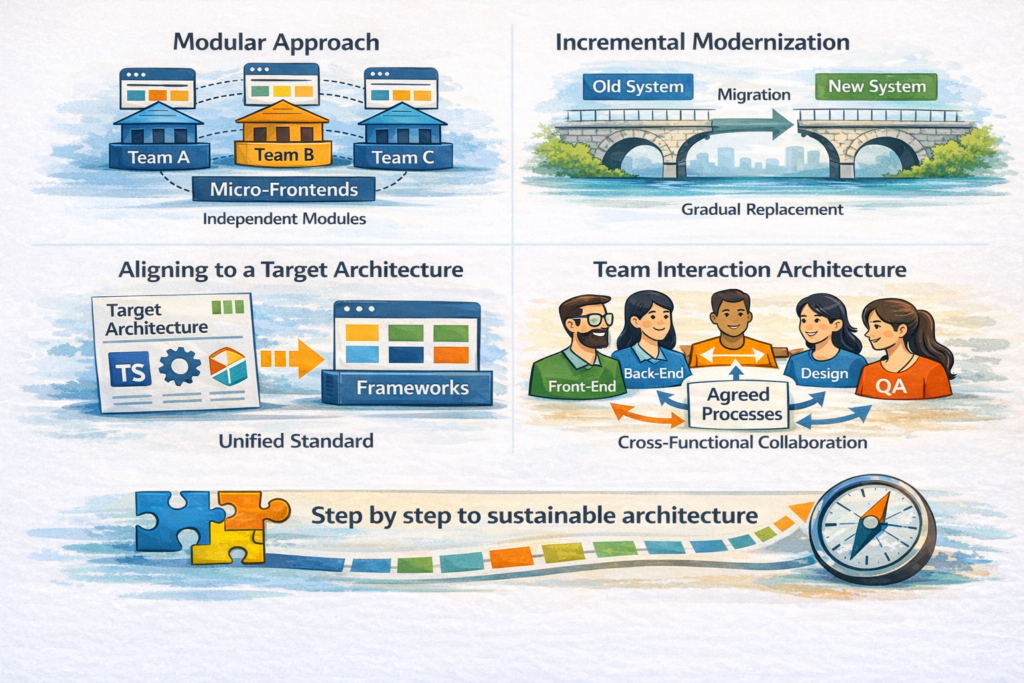
Source: Image generated via ChatGPT 5.2 by Volodymyr Kazakov
Front-end architecture directly affects how fast technical debt grows and how painful it is to reduce. Below are four practical approaches that often work in large products.
- Modular approach. When a front-end turns into a monolith shared by many teams, the symptoms are predictable. Releases slow down, a change in one place breaks another, onboarding takes weeks, and people become afraid to touch the code. A modular approach through micro-frontends offers a different model. You split the product into autonomous vertical modules with independent development and deployment. This reduces cognitive load and keeps debt contained within a specific domain.
- Incremental modernization. A full rewrite from scratch is almost always risky. The product stalls, the business loses momentum, and the new version spends years trying to catch up with features and edge cases. A safer strategy is to replace old parts gradually while allowing both approaches to coexist for a while. The key requirement is clear interfaces between the old and the new, plus a migration roadmap so temporary bridges do not become permanent.
- Aligning to a target architecture. Debt is harder to manage when the current state and the intended state are not written down. A useful practice is to move the codebase toward a target architecture in a consistent way. The goal is fewer mismatched technologies, less duplication, and cleaner module boundaries. In front-end work this often means one modern framework, TypeScript as the standard, one state management strategy, and a shared design system.
- Team interaction architecture. Debt does not come only from code. It also comes from gaps between front-end, back end, design, and QA. A cross functional model can help here. It relies on agreed contracts, early involvement from design and QA, and clear ownership boundaries.
Break the system into manageable modules, migrate in small steps, treat the target architecture as a compass, and design the workflow so teams do not block each other. This slows down debt growth and makes repayment more predictable.
From a chaotic Front-End to a manageable architecture with Fordewind
Front-end technical debt does not appear in one day. Years of rushed releases and temporary workarounds gradually slow the product down. Changes become harder and harder, and the team feels that the front-end has stopped being a support for the business. Fordewind works with exactly these situations.
We start with an honest diagnosis of the current state of the project. Then we shape the target picture together with you. We define what the front-end should be like in one or two years so it supports the product strategy instead of slowing it down. This includes choosing a single technology stack, a thought out modular structure if it makes sense, a design system, and a testing approach that allows you to change code without pain.
If your front-end is already tired of temporary solutions and every release turns into stress, Fordewind can become a partner that helps turn technical debt from an unmanaged problem into a planned process. As a result, you get predictable releases, a cleaner architecture, and a front-end that is ready to scale with the product.
Conclusions
Front-end technical debt builds up quietly. Small compromises, temporary fixes, and postponed improvements turn into a systemic problem over time. At some point the team spends more energy on maintenance than on product growth. This can be managed. Large companies show that investing in updates and improvements increases team productivity and speeds up production changes.
Do not postpone it. Take the first three steps now:
- Run a quick audit, find 3 to 5 problem areas.
- Prioritize the debt, start with what blocks releases, breaks UX, or increases development time.
- Start a small improvement loop, add one concrete task to the next sprint. This can be a module refactor, test coverage or something similar.
Technical debt is not a sentence. It is a normal backlog that needs discipline and a steady rhythm. Take control of it and you get a faster team, cleaner code, and a product that is ready to scale.