
✆ + 1-646-235-9076 ⏱ Mon - Fri: 24h/day
Smart Traffic Signals: How IoT Improves Urban Traffic Management

Drivers lose almost a full work week each year to city traffic. In 2024, large metros like New York and Chicago saw more than 102 hours of congestion time, which meant over $1,800 in direct losses per driver. Urbanization keeps adding pressure. More than half of the world already lives in cities, by 2050 the urban share could reach about 68%. Building new interchanges or widening roads is expensive, it is often hard to do in dense areas. That is why more cities rely on IoT and smart traffic signals that manage flow using real-time data. Next, we look at the main problems, practical rollout approaches, and the results these systems deliver for cities.
Congestion and the pressures of urban growth
City traffic is no longer just an inconvenience. It costs time, money, and productivity. In many cities, congestion is rising again as people return to offices and city centers get busy.
- The economic impact shows up every day. Time spent in traffic means lost work time, extra fuel costs, and lower quality of life. TomTom data puts New York’s congestion level at around 35%, so a 30 minute rush hour trip typically takes about 10 minutes longer. For businesses, that turns into higher logistics costs and delays.
- There are health and safety impacts too. Long idling increases exhaust concentrations near intersections, it adds stress. Congestion also slows emergency services, stop start traffic increases crash risk through the accordion effect.
- Environmental costs are significant as well. Transport is one of the main sources of city emissions, idling in traffic means extra CO2 and other pollutants. Noise levels rise during peak hours, this reduces comfort in residential areas.
- Fixed traffic signal timing makes the problem worse. Timers tuned for average conditions do not reflect real demand, drivers can sit at a red light on an empty road, or get stuck behind a green phase that is too short. Delays pile up, congestion becomes chronic.
Cities lose competitiveness, businesses pay more for transport, the environment suffers, infrastructure wears out faster. Without new approaches, the pressure will keep growing, cities need ways to manage traffic more efficiently without constantly expanding roads.
IoT and smart traffic signals
IoT in transport means a network of connected devices that collect traffic data and feed it into traffic control. The most visible example is smart traffic signals that adjust to real demand instead of fixed averages.
Intersections use cameras, radar, infrared sensors, or inductive loops in the pavement. They measure traffic volume, speed, and queue length in each lane. Data goes to the signal controller or a city traffic center, then the system updates phase timing. If one approach builds a queue, the green phase is extended there. When traffic is light, the system avoids long waits on empty directions. Estimates suggest adaptive control can cut average intersection delays by 20% to 40% compared to static timers.
Beyond adaptive phases, IoT enables a few practical functions.
- Priority for emergency services and public transport. The signal receives a notice that an ambulance or bus is approaching, it creates a green corridor. This reduces response times and improves schedule reliability.
- Signal coordination along corridors. Signals work as a system and align phases to create a green wave, reducing stops.
- Monitoring and prediction. Operators see network load in real time, they can adjust timing plans faster. Stored data can help predict congestion and react before it fully forms.
- More flexible infrastructure control. In some cities, sensors and electronic signs support dynamic lanes. In Los Angeles, these tools on selected corridors reduced travel time by up to 16% and cut emissions by about 14% by smoothing traffic flow.
- Asset condition support. Sensors on bridges and road structures can flag wear, helping plan repairs and avoid sudden closures that trigger congestion.
IoT makes traffic control more flexible. The system adapts to changing flow, supports priority for critical vehicles, it gives cities tools for steadier movement without constant road expansion.
Smart traffic in action
IoT to reduce congestion is already working in real cities. Here are a few examples.
- Pittsburgh, US. It was one of the first cities to test AI-driven traffic signals. The system used data from road sensors and optimized intersection timing in real time. In the pilot, average waiting time fell by about 40%, travel time dropped by 26%, emissions fell by 21% because there was less idling.
- Los Angeles, US. The city has long used the centralized ATSAC system, it evolved from cameras and detectors into deeper IoT integration. Thousands of sensors feed data into a control center where signal plans are adjusted automatically. The city also uses reversible lanes with connected electronic signs. In the morning, lanes open toward downtown, in the evening they switch direction. On routes with adaptive signals, travel time dropped by up to 16%, emissions fell by about 14%.
- Singapore. The LTA combines an IoT network of sensors and cameras with predictive analytics. It pulls data from road sensors, GPS in public transport, and cameras to forecast congestion about an hour ahead. Based on the forecast, the city updates signal timing plans in advance, it can also adjust toll prices in real time to spread demand. In tests, forecast accuracy was above 90%.
- New York City, US. The city upgraded its signal infrastructure and installed IoT devices at 14,000 intersections across all five boroughs. Signals, detectors, cameras, and information boards were connected into one system through cellular routers and a secured wireless network. After the upgrade, connectivity and signal reliability increased to 99%. The system integrates with FirstNet, which can provide priority for emergency vehicles.
- Google Project Green Light. Google improves signal timing without adding new sensors. Its models analyze anonymized Google Maps data and generate timing recommendations that city engineers implement. In pilots covering more than 70 intersections, stops dropped by up to 30%, emissions at intersections fell by more than 10%.
These cases show a clear impact. Fewer delays and stops, lower emissions, better control across the network.
Architecture of an IoT-based traffic management system
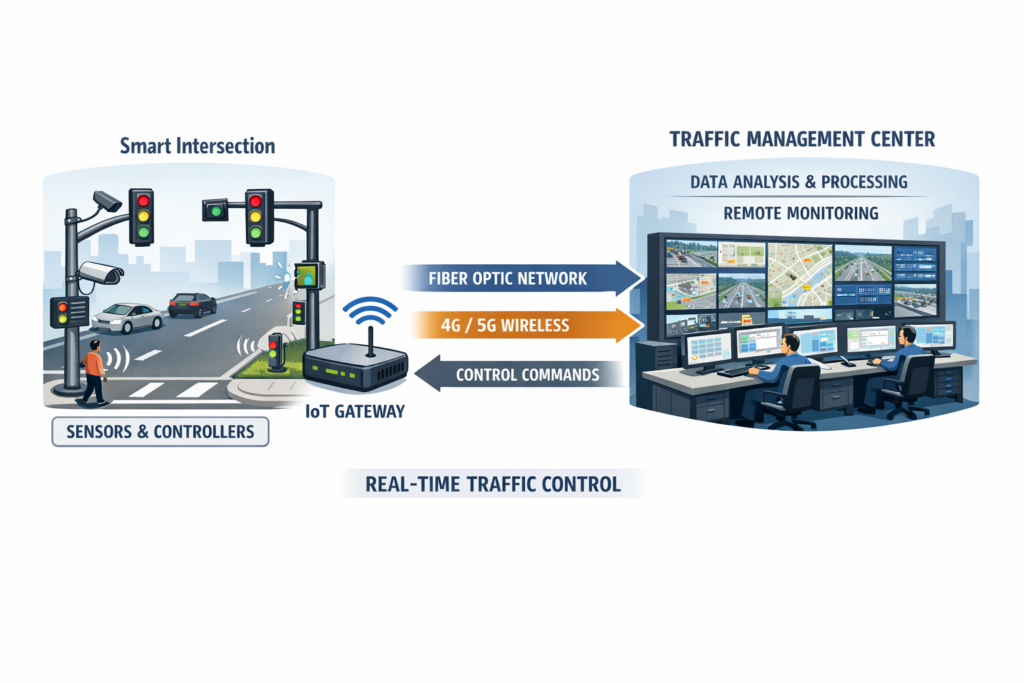
Source: Image generated via ChatGPT 5.2 by Volodymyr Kazakov
An IoT traffic management system works as one connected mechanism with several layers. It combines field sensors, local controllers, communications, a central data platform, and operator interfaces plus integrations.
Data collection layer
Roadside devices include traffic flow sensors, cameras, weather sensors, and signal controllers. At an intersection, there is usually a control cabinet that holds the controller, networking gear, and power equipment. Data from inductive loops, magnetic detectors, or video analytics goes into the controller. Some processing happens on site, then the data is prepared for transmission.
Communication network
Intersections connect to the control center through secured links. The most common options are LTE or 5G, or fiber. A rugged industrial router in the cabinet collects traffic from the local network and forwards it to the central system. For reliability, cities may use redundancy such as two operators or two different links. This helps avoid downtime without running cables to every location.
Central platform
A platform runs in a city control center or in the cloud. It receives data from intersections, stores history, analyzes current conditions, it sends control commands back. It usually includes ingestion services and databases, analytics modules, and AI for signal timing optimization, incident detection, and load forecasting. Another layer is the operator consoles. They show a city map, signal status, and congestion levels. An operator can override automation when needed, for example to set a detour plan or give priority to emergency vehicles. For long term planning, the platform produces reports that highlight recurring bottlenecks and the impact of changes.
Data exchange with other systems
Some data is shared through integrations. Navigation services can consume live congestion information. Some cities test V2I, where infrastructure sends signal data to vehicles and receives extra flow details back. Integrations with smart parking and broader city platforms are also possible. These can combine traffic with weather, air quality, and events to support coordinated decisions.
Security and reliability
Signals are network-connected, so secure links and access control are critical. Cities use network segmentation, encryption, VPNs, and role-based access. For continuous operation, key nodes often have backup connectivity and power. This reduces the risk of failures that can quickly turn into traffic chaos.
Overall, the system repeats a cycle of measurement, analysis, and action. It updates control every second, it gives the city a flexible, scalable way to manage traffic.
Fordewind: full-cycle IoT engineering from sensor to platform
Any project in traffic, energy, manufacturing, or city infrastructure comes down to a simple question. Can the system collect data reliably, turn it into decisions fast, and stay manageable as it scales. Fordewind is a partner with deep IoT expertise that builds end-to-end products and platforms.
Fordewind treats IoT as one system, not a set of parts. Field devices, firmware and protocols, networks and gateways, edge processing, cloud, event analytics, backend services, integrations, monitoring, security, updates, and operations need to work together. Otherwise a pilot looks great, then production breaks because of connectivity gaps, vendor mix, and other real-world issues.
In smart traffic, this is especially clear. Intersection data comes from cameras, radar, inductive loops, signal controllers, and weather sensors. Each source has its own format, accuracy, update rate, and trust level. You need to turn all of that into a reliable event stream with normalization, filtering, quality checks, history, response rules, and clear visibility for operators. That is the difference between a system that only shows numbers and one that actually controls traffic.
There is a strong focus on production readiness. IoT often runs with unstable links, high security requirements, and a need for autonomy. So solutions are designed with local fallback modes, secure authentication, encryption, network segmentation, logging, configuration control, and remote updates that do not risk shutting down critical infrastructure.
If you need an IoT product that will not get stuck at the demo stage, but can scale, integrate, and run day to day, Fordewind can take on the core work. Architecture, tech stack, platforms and services, analytics, and support. The result is a working system that delivers real impact and is ready to grow.
Conclusion
Smart traffic signals and IoT traffic management systems have already proven their value in cities around the world. They cut delays, reduce fuel waste, and improve air quality. The investment often pays back through saved time and lower operating costs. At scale, smart traffic control can deliver major savings for cities, mostly by reducing the losses caused by congestion.
For city leaders and investors, this is a practical path forward. Start with a pilot at key intersections, budget for sensors, connectivity, and a control platform. Then expand to the corridors with the biggest problems. These technologies should sit inside the city’s transport strategy, not as a one-off experiment.