
✆ + 1-646-235-9076 ⏱ Mon - Fri: 24h/day
Smart Shelters How IoT Is Redefining Civil Safety in the Age of Uncertainty

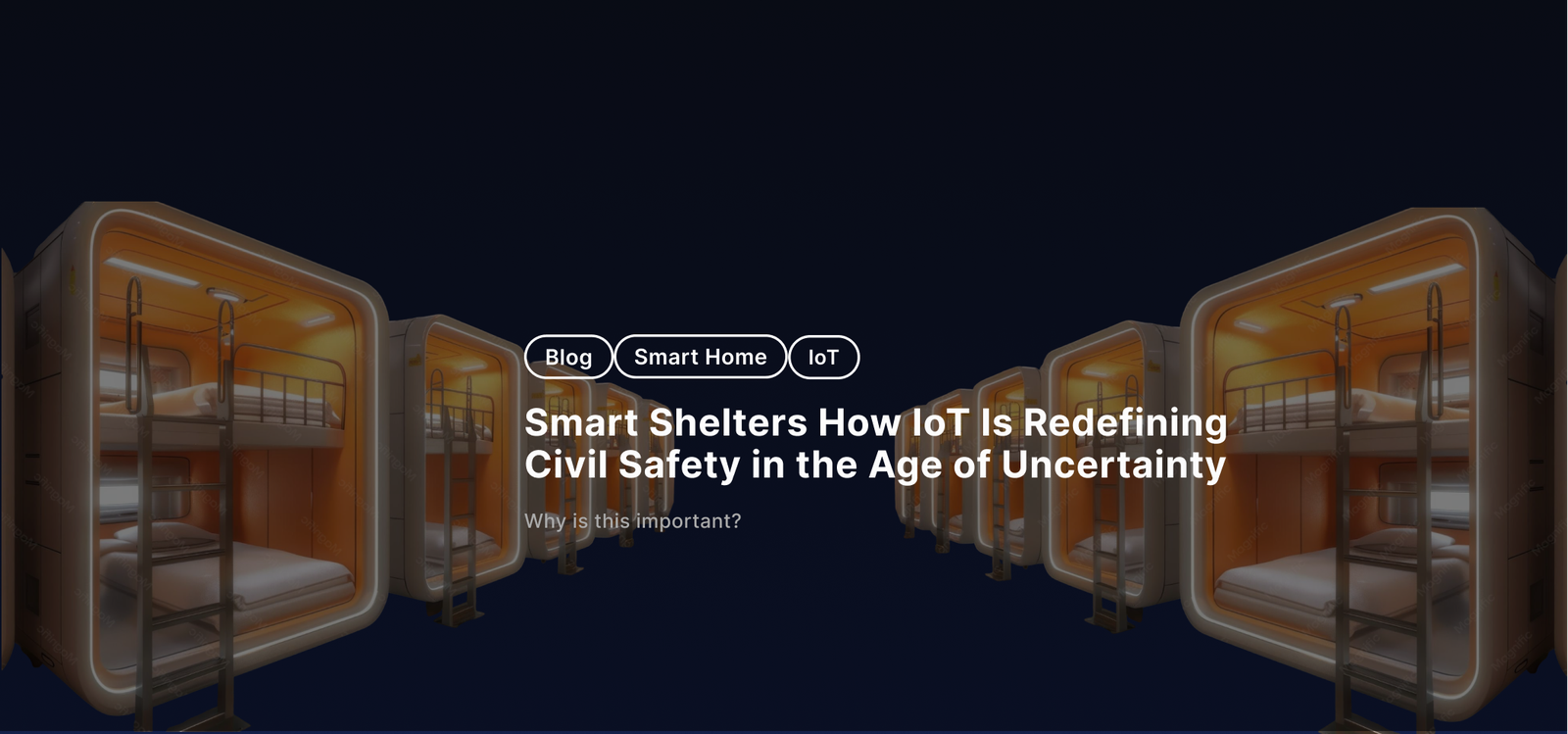
In the modern world, the safety of the civilian population has become one of the main challenges. Wars, natural disasters, and industrial accidents show that traditional shelters do not fully meet people’s needs — not only in terms of security, as they lack monitoring systems, communication capabilities, or autonomous control, but also in terms of basic comfort, as they are not always equipped with Wi-Fi or even mobile connectivity.
Therefore, the new concept of a Smart Shelter, which can be considered a part of the Smart City ecosystem, is highly promising. In general, it is a shelter equipped with sensors, networking technologies, and analytical systems capable of responding to changes in real time.
A key role in this is played by the Internet of Things (IoT) — a network of interconnected devices that collect and transmit data to create a safe, adaptive, and autonomous environment. Smart Shelters represent a direction that may allow us in the future to build solutions where technology ensures not only comfort but also survival.
What Are Smart Shelters?
Smart Shelters represent a new generation of protective facilities where IoT technologies, analytics, and automation are combined to ensure maximum safety and autonomy.
These systems integrate sensors, networking devices, analytical modules, and control interfaces, forming a cohesive infrastructure capable of operating without constant human intervention.
The core idea of a Smart Shelter lies in real-time monitoring, automation, communication, and analytics.
This means that the system not only records environmental indicators but also analyzes them and reacts — for example, notifying about reduced oxygen levels, activating ventilation, or sending data to a control center.
Typical examples of Smart Shelter subsystems include:
- Air quality control: measuring CO₂ and oxygen levels, humidity, and toxic gases.
- Supply monitoring: automated tracking of food, water, and medical resources.
- Energy management: controlling generators, batteries, and solar panel.
- Human condition monitoring: biosensors that track body temperature, heart rate, or stress levels.
The Architecture of a Smart Shelter System
The recommended Smart Shelter architecture is an ecosystem in which each layer performs its own function, ensuring reliability, autonomy, and rapid response. It should be designed based on modularity and scalability principles, allowing the shelter to adapt to different environments — from urban civil defense bunkers to mobile field bases.
1. Sensor Layer
This layer is responsible for real-time data collection. It consists of a large number of sensors and devices that constantly monitor environmental parameters and the condition of people inside.
Typical sensors include:
- Environmental sensors: CO₂, temperature, humidity, and hazardous gas concentration (e.g., methane or carbon monoxide).
- Infrastructure sensors: monitoring generator status, fuel levels, water pressure, or ventilation systems.
- Motion and access sensors: for detecting intrusions or evacuation scenarios.
This layer forms the foundation of the data that will be transmitted upward for processing and analysis.
2. Communication Layer
This layer ensures data transmission between sensors, gateways, analytical platforms, and external systems. Depending on the environment and power consumption requirements, different technologies may be used:
- MQTT (Message Queuing Telemetry Transport): a popular lightweight protocol for IoT communication.
- LTE/5G: for high-speed transmission of large data streams, including video feeds.
This layer must be fault-tolerant and have redundant channels — for example, satellite communication or a local network in case of Internet outages.
3. Analytical Layer
A layer for processing collected data. The analytical layer can utilize artificial intelligence, machine learning, and predictive analytics to:
- Identify potential hazards (e.g., low oxygen or overheating)
- Predict the needs of occupants (food, medication, energy)
- Detect anomalous situations (sudden temperature changes, power failures)
- Trigger automated actions (activating ventilation, notifying operators, etc.)
Implementation may use platforms such as TensorFlow or AWS IoT Analytics, with data stored in PostgreSQL or MongoDB.
4. User Interface Layer
This layer enables people to interact with and leverage the advantages of a Smart Shelter. Interface formats may include:
- Monitoring dashboards that display shelter status, number of occupants, resource levels, and environmental conditions
- Mobile applications for receiving alerts or sending SOS requests
- Integration with municipal systems, such as dispatch centers or civil protection services.
The interface is critical for coordinating actions during emergencies, as it enables rapid response even if users are not physically present in the shelter.
Benefits of IoT-Driven Shelters
The integration of IoT into Smart Shelter systems unlocks new possibilities for safety, comfort, and efficient management during emergency situations. With sensors deployed throughout the shelter, the system can continuously monitor temperature, humidity, CO₂ levels, oxygen concentration, and other critical environmental parameters, ensuring optimal living conditions even under full isolation from the outside world. In the event of danger or technical failure, the system automatically responds: it highlights emergency exits, activates ventilation and air-filtration systems, and notifies operators and occupants through mobile applications or centralized communication channels.
Beyond safety, Smart Shelters enable efficient management of resources — electricity, water, ventilation, heating, and food supplies. Using AI-driven analytics, the system can calculate consumption and optimize usage, extending autonomous operation even when resources are limited. Continuous analytics allow not only monitoring of the current state of the shelter but also predicting potential issues: overcrowding, equipment wear, reduced filter efficiency, or battery degradation.
By enhancing automation, data transparency, and response speed, Smart Shelters demonstrate how technology can not only save lives but also create a sense of confidence among citizens. This represents a shift from a reactive model of responding to threats toward a proactive one — where risks are anticipated before they become critical.
Challenges and Risks
Despite the clear advantages of the Smart Shelter concept, its implementation comes with a number of critical challenges and risks that require attention and mitigation strategies.
- Data Security
One of the main risks is the threat of cyberattacks and unauthorized access. A compromised Smart Shelter system could reveal the shelter’s location, the number of people inside, or even intercept emergency signals. Such breaches may lead to not only technical failures but also direct threats to human life. Therefore, strong encryption, secure user authentication, and continuous cybersecurity monitoring are essential.
- Privacy
The system may collect geolocation and behavioral data, for example, to track occupancy during emergencies. This creates risks related to privacy violations and unauthorized use of personal information. Ensuring data anonymization, transparent data retention policies, and compliance with data protection laws (such as GDPR) is crucial.
- Dependence on Power Supply and Connectivity
Most IoT devices rely heavily on reliable power and stable network connectivity. During warfare or emergency scenarios, loss of electricity or internet access can paralyze the entire system. For this reason, autonomous solutions are needed — such as solar power systems, backup batteries, and local communication networks that operate without centralized internet access.
- Need for Government Regulation
The development of Smart Shelters requires unified standards and protocols for IoT devices in the security domain. Without this, systems may become incompatible, slowing down widespread deployment. Additionally, legal regulations must define requirements for data storage, transmission, usage, and the accountability of involved parties in case of technical failures or data breaches.
In summary, the key challenges of Smart Shelters extend beyond technical implementation — they lie in building trust, ensuring reliability, and maintaining legal compliance. Overcoming these risks is critical for the large-scale adoption of systems designed to protect civilian populations in modern threat environments.
Future Perspectives of Smart Shelters
The next step in the evolution of Smart Shelters is the implementation of artificial intelligence, which enables not only the collection and transmission of data but also its transformation into practical, actionable decisions for rapid response and shelter management. At the analytical level, AI processes large volumes of sensor data — including temperature, humidity, CO₂ concentration, occupancy, energy consumption, and resource levels — and uses it to generate risk predictions. For instance, AI can anticipate shelter overcrowding or potential ventilation issues, as well as detect abnormal conditions that may indicate technical failures or emergency situations.
Additionally, an AI assistant could be introduced to help individuals in the shelter access critical information and receive guidance on stress reduction and emotional well-being.
Adaptive control algorithms allow the shelter to respond to real-time changes in an autonomous manner. This includes automated ventilation and lighting adjustments, optimization of energy and water consumption, resource allocation among occupants, and activation of emergency alerts. AI can also integrate with municipal infrastructure and emergency response systems, predicting risks at a district or city level and assisting operators in making fast and accurate decisions.
The combination of IoT and AI ensures high adaptability, reduces human involvement in critical scenarios, and enhances overall civilian safety. Moreover, machine-learning models continuously improve based on historical data, enabling the prediction of scenarios that are difficult to anticipate using traditional management approaches. This transforms Smart Shelters from passive protective structures into active, self-regulating civil defense systems capable of responding to a wide range of threats in real time.
Conclusion
Smart Shelters, combined with IoT and AI, shape a new paradigm of civil protection where the safety of citizens is ensured not only through physical infrastructure but also through real-time data, analytics, and automated management. Sensors and IoT devices continuously monitor air quality, CO₂ concentration, temperature, energy and food supplies, while AI analytics transforms this data into risk predictions and operational recommendations. As a result, shelters become adaptive: they can automatically regulate ventilation, lighting, resource distribution, and emergency signals based on current conditions and forecasted threats.
The advantages of such systems are clear — rapid response in critical situations, efficient resource utilization, increased public trust in civil defense systems, and improved coordination with municipal services. However, it remains essential to maintain a balance between technological advancement and security: there are risks of data breaches, cyberattacks, excessive collection of biometric or behavioral information, high modernization costs, and dependency on power and communication infrastructure. Compliance with security standards, the adoption of autonomous backup systems, and appropriate governmental regulation are crucial to ensure the effectiveness and reliability of Smart Shelters.