
✆ + 1-646-235-9076 ⏱ Mon - Fri: 24h/day
Mobile Apps for Farmers: How IoT Improves Agricultural Efficiency

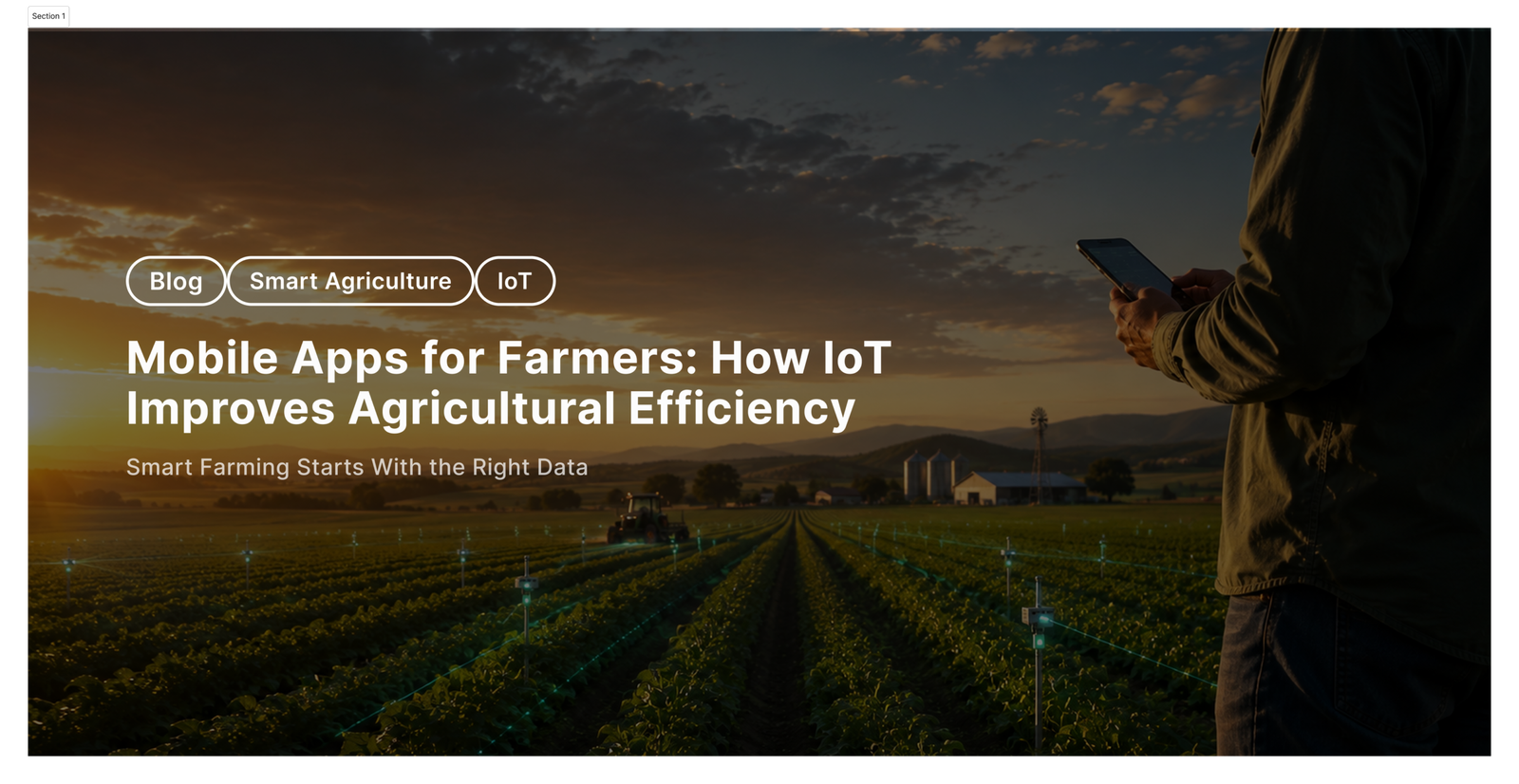
Modern farming is no longer based on intuition but on data accessible from a smartphone. Just a decade ago this seemed like science fiction, yet today the Internet of Things (IoT) is transforming agriculture at a critical moment. By 2050 the global population is expected to reach 9.7 billion, requiring much higher food production, while climate change brings frequent droughts and floods that threaten harvests. With labor shortages adding pressure, farmers are turning to technology to increase productivity.
The challenge is clear: how to grow more high-quality produce with limited resources and rising costs? Agriculture consumes about 70% of the world’s freshwater, much of it lost through inefficient irrigation, while volatile fertilizer and fuel prices and vast farmland management make traditional methods insufficient.
IoT offers a solution through networks of connected sensors and devices that gather field data and deliver it to mobile apps. This article explores the problems IoT addresses, its impact on efficiency, and real-world examples of smart agricultural solutions.
Challenges and Issues in the Agricultural Sector
Modern agriculture faces a number of systemic challenges:
- Global demand growth. The world’s population is increasing, and with it – food consumption. However, the amount of arable land is limited, so farmers must get more production from every hectare. This requires new approaches to yield management and minimizing losses.
- Resource constraints. Water, soil fertility, fertilizers – all of these resources are finite. As noted above, agriculture already uses up to 70% of the available freshwater. It is necessary to reduce resource waste. For example, implementing sensor-based precision irrigation can cut water use by up to 40% compared to traditional methods. This is a significant saving, especially in drought-prone regions.
- Climate change and weather unpredictability. Climate change leads to extreme weather events – abnormal droughts, heavy rains, temperature stresses for plants. In such conditions, the traditional calendar-based approach fails. Farmers need real-time data (on soil moisture, precipitation, frost, etc.) to respond quickly to weather fluctuations.
- Labor shortages and urbanization. Young people are moving en masse to cities, and the average age of farmers is rising. In some countries, there is a shortage of workers for seasonal fieldwork. Automation and remote monitoring partially address the lack of hands and skilled labor. Robots, drones, and smart systems take over routine tasks, allowing smaller teams to manage larger areas.
- High costs and risks. Agriculture is a business with high risks and low margins. Misjudging field conditions or delaying a response to plant diseases can cost farmers a significant share of income. Market analysis shows that the adoption of digital technologies in agriculture is already accelerating – the IoT in agriculture market is growing annually by 10% and is expected to reach $28.5 billion by 2030. This means competitors are already investing in AgTech to cut costs and increase returns. Therefore, staying aside means losing competitive advantages.
Food security challenges, limited resources, and climate risks require farmers to adopt a more precise, data-driven approach to crop and livestock management. Next, we will look at how IoT technologies, integrated into mobile applications, offer concrete solutions to these challenges.
How IoT Solves Farming Challenges
IoT technologies can transform agriculture in several directions at once. According to industry reviews, at least six key aspects of farming can be improved with the help of smart sensors and systems:
- Data monitoring. A multitude of sensors in the field and on the farm continuously collect tons of data: from weather conditions and soil moisture to crop status and animal health. This data provides a complete picture of what is happening on the farm in real time.
- Better control and reduced risks. Farmers gain full control over internal processes and can respond quickly to changes, reducing production risks. Knowing the predicted yield makes it easier to plan sales; tracking the health of crops or livestock allows diseases to be prevented before they cause losses.
- Cost optimization and loss reduction. Constant monitoring of fields and farms makes it possible to spot deviations in time – for example, pest outbreaks or signs of plant stress – and take action to save the harvest. This minimizes losses and prevents the wasteful use of resources (water, fertilizers, feed).
- Process automation. Smart devices can automatically perform many routine operations – from irrigation to fertilization or activating ventilation in storage facilities. Such automation improves efficiency and responsiveness, freeing up time for more complex tasks.
- Improved quality and yield. Thanks to better control and precise adherence to growing conditions, both output and product quality increase. Automated systems help maintain optimal microclimate parameters, leading to consistently high yields and improved agricultural product quality.
- Reduced environmental impact. Smart farms are more sustainable and eco-friendly. Targeted application of fertilizers and pesticides, along with optimized irrigation, helps reduce excessive use of chemicals and water, thereby lowering soil pollution and greenhouse gas emissions.
IoT enables farmers to see the invisible and control what was previously uncontrollable. Let’s take a closer look at the main IoT-based solutions already being implemented on farms today.
IoT Architecture: How It Works Technically
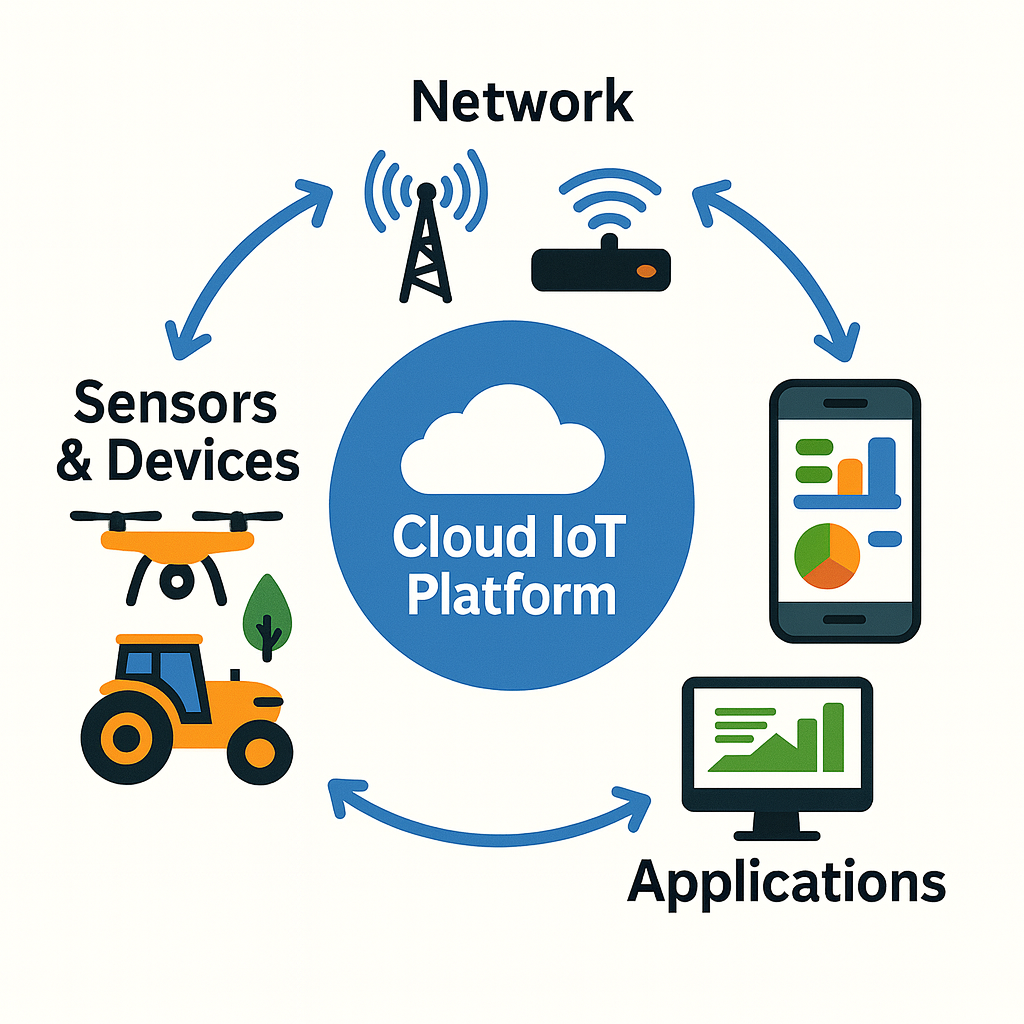
Source: Image generated via ChatGPT 5 by Volodymyr Kazakov
A typical IoT system in agriculture consists of several layers that connect the physical farm environment with the farmer’s smartphone.
- Perception layer (sensors and devices). This includes soil moisture and temperature sensors, light sensors, pH meters, drone cameras, livestock collars, water flow meters, and actuators such as irrigation valves, pumps, and ventilation systems. Sensors continuously measure parameters and send data, often powered by batteries or solar panels to operate autonomously for years in remote locations.
- Network and communication layer. Data from sensors is transmitted via different wireless technologies depending on distance and environment. In rural areas, LPWAN protocols such as LoRaWAN, NB-IoT, or Sigfox are common, as they enable long-distance, low-power communication. For local networks, Wi-Fi, Bluetooth, or mobile connectivity (3G/4G/5G) may be used. Gateways collect data from nearby sensors and forward it to the internet, acting as bridges between the field and the cloud.
- Cloud platform and data processing. Sensor data is stored and analyzed in the cloud. The IoT platform visualizes readings, applies analytics and AI models, and can automatically trigger actions. For example, if soil moisture falls below 30%, the system can activate irrigation for 20 minutes. Platforms also integrate with weather forecasts or satellite imagery for deeper insights, enabling predictive yield analysis or disease detection.
- Application layer. Farmers interact with the system through mobile apps or web portals. Modern apps provide real-time dashboards, historical graphs, and push notifications (e.g., “excessive soil moisture detected”). Users can remotely control devices such as pumps or feeding robots, while automation handles routine actions. In effect, the system works like an “autopilot” for the farm, executing predefined rules while keeping the farmer informed.
Overall, an IoT solution in agriculture is a multi-layer ecosystem: sensors → network → cloud → application. Each layer is critical for reliable operation, and design must consider challenges such as lack of power or internet in rural areas, weatherproofing, and data security. With robust architecture, IoT platforms can function even in remote fields, enabling digital transformation across the agricultural sector.
Examples of IoT Implementation in Agriculture
Smart agricultural technologies are no longer just theory – farmers and agribusinesses in various countries are already using them successfully. Here are just a few illustrative examples:
- HydroPoint (California, USA) – smart irrigation and water savings. This company developed a soil and weather monitoring system connected to irrigation pumps and valves. Based on soil moisture data and rainfall forecasts, algorithms determine when irrigation is needed and automatically deliver exactly the right amount of water to the plants. Farmers reported that with HydroPoint they reduced water and electricity consumption, cutting irrigation costs by 30-50%, while maintaining consistently high yields. In addition, the system provides detailed analytics – where and how much water was used – helping farmers make decisions about modernizing their irrigation infrastructure.
- Orisha (Canada) – remote Greenhouse Management. Orisha developed a smart system that automates greenhouse operations for small farmers. By installing affordable controllers on ventilation windows, pumps, and thermostats, and connecting them to the internet, farmers can manage conditions through a mobile app. They set parameters like maximum daytime temperature or minimum soil moisture, and the system adjusts equipment automatically. Farmers receive alerts about completed actions or emergencies, such as a malfunctioning fan. This solution helps even small farms maintain stable growing conditions, reduce energy use, increase yields, and save time by managing greenhouses remotely.
These cases show that the combination of IoT devices and well-designed software solutions truly works on farms, delivering measurable results – resource savings, increased yields and profits, and improved product quality. Importantly, all the examples highlight mobile applications as the interface for end users (farmers or agronomists). This way, even complex high-tech systems become convenient and intuitive for everyday use.
Agriculture Asset Tracking System (Fordewind.io) – application for monitoring people in an agricultural zone with working machinery
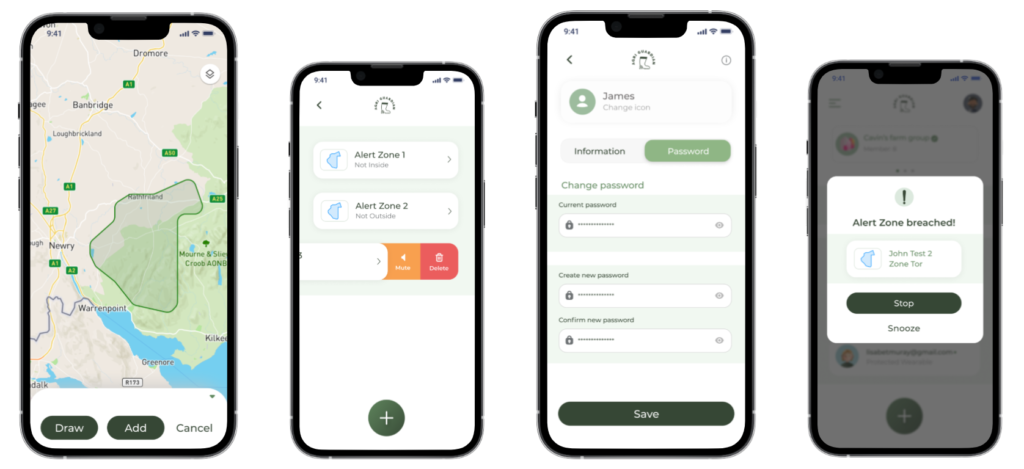
Source: fordewind.io
Imagine a farm during harvest season: large combines and tractors move across the field, people work nearby, and the risk of dangerous situations is quite high. To reduce these risks, the Fordewind.io team developed the mobile application Agriculture Asset Tracking System. It allows real-time tracking of people’s locations and ensures quick communication among all participants. This is an example of how digital solutions combine safety, organization, and convenience in a farmer’s daily work.
What the system can do:
- Real-time location tracking. Users carry portable devices that transmit their location, allowing others to monitor their presence on the farm. This is especially important on large fields where machinery and people are spread out.
- Creates “virtual fences.” These can be placed around potential hazards, triggering alerts if a user enters a restricted zone. This way, farmers can be sure no one accidentally enters a dangerous area.
- Provides an instant SOS signal. In case of danger, a person can press a button and immediately call for help – with exact coordinates. This is critical when every minute counts.
- Enables team communication. Users can make and receive group calls through the app, simplifying coordination and assistance.
- Connects family members. Parents or children can monitor the safety of their loved ones remotely. This provides peace of mind and a sense of control for those worried about family members.
- Flexible customization. Different subscription packages are available – for small farms and large agribusinesses, with options to add extra features as the farm’s needs grow.
Results for farmers:
- Safer work. Real-time tracking and alerts create a reliable safety system. Children are kept out of dangerous zones, elderly people can quickly send an SOS signal, and family members can remotely monitor the situation. Workers benefit from better coordination and support, even in remote areas.
- Peace of mind and confidence. Instant notifications reduce anxiety for farmers and their families, allowing them to focus on their work. This improves quality of life, enhances sleep, and creates a more positive atmosphere on the farm.
- Better organization. The system optimizes communication and resource allocation, reducing downtime and ensuring quick responses in critical situations. This makes workflows uninterrupted and more efficient.
- Flexibility for any farm. The solution is suitable for both small family farms and large agribusinesses, easily scalable, and integrable with existing farm management software.
As a result, farmers receive not just an app, but a comprehensive safety and organization system. It makes fieldwork safer, calmer, and more efficient, and most importantly – it ensures that even in the toughest conditions, people remain protected.
Conclusion
The Internet of Things combined with mobile applications is ushering in a new era for agriculture – the era of “smart” farming. With IoT, farmers gain transparency across all processes (from field to storage), rely on data instead of intuition or years of trial and error, and ultimately increase the efficiency of their business. Real-world examples prove that implementing smart systems delivers tangible results: saving water and resources, reducing costs, boosting yields and product quality, and making farm work easier for people on the ground.
For agribusinesses, farming cooperatives, or even individual farms, now is the best time to adopt innovation. IoT technologies are rapidly becoming more affordable and accessible, while competition demands staying one step ahead. Don’t wait until traditional methods start slowing down your farm’s growth. Start small – connect a few fields or farms to smart sensors, launch a pilot project, and see the benefits for yourself.
Fordewind.io specializes in developing IoT solutions and mobile applications for the agricultural sector, creating tools that have proven their effectiveness in real-world conditions.
Ready to take the first step toward a “smart” farm? Reach out to the Fordewind.io team for a consultation or to develop a tailored solution for your farm. Invest in IoT-powered mobile applications today – and in the very next season, you’ll enjoy higher yields, lower costs, and significantly improved safety and efficiency.