
✆ + 1-646-235-9076 ⏱ Mon - Fri: 24h/day
The Invisible Cost of Bad Architecture: What Every CEO Should Know

Most CEOs understand marketing budgets, salaries, and operations, but few realize how much money leaks silently through poor infrastructure decisions.
Bad architecture doesn’t fail loudly; it fails quietly and expensively through overprovisioning, downtime, and unnecessary dependencies.
Let’s explore how to recognize, quantify, and fix the hidden costs of weak architectural decisions before they start draining your profits.
Why CEOs Should Care About Architecture Costs
Infrastructure architecture is both technical and a financial concern. Every design decision has a cost attached to it, whether you see it on an invoice or not.
- Poorly designed systems lead to downtime, resulting in lost transactions and damage to reputation.
- Overengineered systems waste resources and salaries.
- Vendor lock-in can create years of dependency, turning your IT budget into a hostage situation.
The Myth of 99.999% Uptime
Every business wants reliability, but each extra “nine” in uptime will cost exponentially more:
| Uptime Target | Downtime per Year | Relative Cost Multiplier |
| 99% | ~3.65 days | baseline |
| 99.9% (three nines) | ~8.76 hours | × 2–3 |
| 99.99% (four nines) | ~52 minutes | × 5–10 |
| 99.999% (five nines) | ~5 minutes | × 15–20 |
| 99.9999% (six nines) | ~30 seconds | × 30+ |
Each additional “nine” often requires redundant regions, auto-failover systems, dual cloud providers, and 24/7 staffing.
The question every CEO should ask is not “Can we reach five nines?” but “Do we really need to?”
For a banking app, the answer is yes.
For an internal analytics dashboard, absolutely not.
Understanding the cost per nine helps leaders make rational, ROI-based decisions about reliability, instead of chasing vanity metrics.
Why Companies Need Cost Reports per Project
Without visibility, cost optimization is impossible. Many organizations operate under one AWS bill, split across multiple teams, with no real understanding of who spends what or why.
A good cost report helps you:
- Identify inefficient services (e.g., paying for unused EC2 instances).
- Spot hidden charges (like data transfer or cross-AZ traffic).
- Track cost trends per environment — dev, stage, prod.
- Justify budget allocation to investors or CFOs.
A clear cost breakdown lets leadership connect financial outcomes to architectural decisions. For example, “Our NAT Gateway traffic costs doubled. Can we use a VPN tunnel instead?”
What Is “Bad Architecture”?
A bad architecture is a system that fails you would think. But actually, the problem is bigger, the problem is deeper, it’s a system that works but does so inefficiently and expensively.
Let’s look at some classic examples of poor design in AWS:
| Bad Choice | Why It’s Bad | Better Alternative |
| Running Fargate + Kubernetes for a few small apps | Overcomplicated orchestration, higher costs for low-load systems | ECS on EC2, or a simple container host using Docker Compose |
| NAT Gateways for every subnet when no internet access is needed | ~$35/month per NAT + egress charges | AWS Client VPN or OpenVPN instance for secure access |
| Oversized instances with 20% utilization | Paying 5× more for unused resources | Downsize to fit real demand; use auto-scaling or spot instances |
| Relying on vendor-managed services for simple tasks | Lock-in and long-term price growth | Self-managed equivalents or hybrid solutions |
The pattern is clear: complexity costs money, especially when it’s unnecessary.
How to Minimize Costs Without Sacrificing Quality
There’s a balance between savings and sustainability. Let’s explore strategies that make sense both technically and financially.
1. Rethink Engineering Costs
You don’t always need a senior DevOps engineer to maintain a small infrastructure. If you have a lightweight system, a serverless or simple Docker-based approach can reduce both engineering hours and salary overhead.
Example:
A Senior DevOps engineer costs ~$100,000/year.
If your infrastructure is simple, shifting to a managed serverless setup (or even a static hosting approach) might reduce maintenance to a few hours per week.
2. Hybrid and Multi-Hosting Strategies
AWS is powerful but not cheap. Providers like Hetzner, OVH, or traditional datacenters can host prototypes, testing, or low-priority environments for a fraction of the cost.
- Use Hetzner or local DCs for early-stage or PoC workloads.
- Keep production on AWS or Azure for compliance and scalability.
- Use cross-VPN connectivity to link both environments securely.
This hybrid approach lets startups grow affordably and transition smoothly when scale demands it.
3. Replace Paid AWS Add-Ons with Open-Source Tools
AWS offers convenience, but convenience adds up. For many tasks, there are reliable, self-hosted alternatives:
| AWS Service | Self-Hosted Alternative |
| AWS VPN Client | OpenVPN / WireGuard (free) |
| AWS WAF | NGINX or HAProxy-based reverse proxy |
| AWS CloudWatch | Zabbix, Prometheus + Grafana |
| AWS ALB | HAProxy / NGINX Load Balancer |
| AWS GuardDuty / Security Hub | Wazuh / OpenSearch Security plugins |
Sometimes, even project managers can oversee these systems through web-based dashboards, reducing dependency on expensive engineers. An easy example is an OpenVPN server with a web UI, even a kid can control it using a mouse and a basic understanding.
Example of a Proven Flexible Architecture
A flexible IoT architecture doesn’t depend on any single provider. It uses portable components and standardized protocols.
Reference Example Cloud-Agnostic IoT System
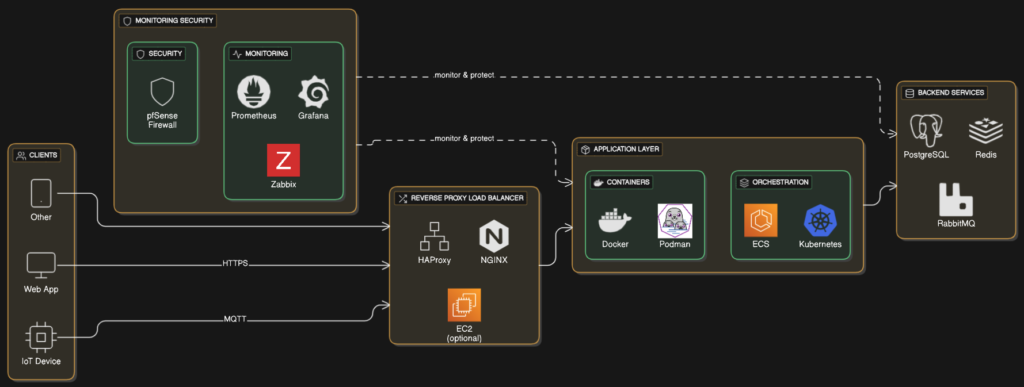
Why It’s Flexible:
- Can run on AWS, Hetzner, or Azure without reengineering.
- Infrastructure managed via Terraform redeploy anywhere.
- All components are open-source and industry-standard.
- No hard lock-in, total control over costs, scaling, and performance.
This is what “future-proof” architecture looks like, resilient yet portable.
How Fordewind.io Helps Companies Avoid Hidden Costs
At Fordewind.io, we’ve seen the cost of bad architecture up close, from startups overpaying for idle infrastructure to enterprises locked into expensive cloud ecosystems.
With experience across hundreds of projects in healthcare, finance, IoT, e-commerce, and smart tech, we help clients:
- Audit and optimize existing infrastructures to cut costs safely.
- Design scalable, flexible platforms with Terraform and containerization.
- Build hybrid infrastructures (Hetzner for PoC, AWS for production).
- Replace vendor-managed services with open-source, self-controlled tools.
- Implement cost transparency dashboards for every environment.
We combine DevOps expertise with a CEO’s mindset, so your infrastructure supports your business, not the other way around.
Conclusion
The cost of bad architecture is invisible until it’s not.
You won’t see it in a crash or a headline, but in quiet, monthly bills and missed opportunities.
Every “nine” of uptime, every unnecessary managed service, every oversized instance, they all have a price. And as a CEO, your job is to know when that price stops being worth it.
At Fordewind.io, we help companies strike a balance between building systems that are reliable, scalable, and secure, but also rational, transparent, and cost-efficient.
Because good architecture isn’t just about technology.
It’s about business sense.