
✆ + 1-646-235-9076 ⏱ Mon - Fri: 24h/day
IoT system for pet care

In today’s fast-paced world, more and more pet owners are forced to leave their beloved animals unattended for extended periods — whether due to work, frequent business trips, or travel. Yet pets’ needs don’t disappear they require regular feeding, access to clean water, monitoring of their health, and, importantly, emotional contact with their owners. That’s why technology has become a crucial ally for anyone who wants their furry friends to feel as comfortable and safe as possible, even when they’re not at home.
The Internet of Things (IoT) opens up exactly these opportunities for pet care. Today, the market offers automatic feeders, smart water dispensers, surveillance cameras with two-way communication, GPS collars, and activity sensors — all of which enable owners to monitor and maintain comfortable conditions for their pets, even from afar.
Especially intriguing are solutions that combine IoT devices with artificial intelligence technologies. For example, systems that analyze a dog’s behavior through a camera and detect whether it looks sad or agitated. This approach not only automates basic tasks like scheduled feeding but also allows owners to respond promptly to changes in their pet’s behavior, preventing potential health issues or stress.
Modern pet care systems are built on the integration of hardware IoT devices, reliable server software, mobile applications for owners, and AI modules for data analysis. Using these solutions makes the care process more efficient, safe, and comfortable for both pets and their owners.
Smart Devices for Pet Care
One of the key enables for creating, developing, and using these systems is smart devices that directly interact with pets and allow for specific functions such as feeding, monitoring, and communication. Examples of such devices, their purposes, and real-life scenarios where they can be useful are presented below.
| Device | Purpose | Real-life Use Cases |
| Automatic feeder | Scheduled or remote feeding of pets | The owner is delayed while running errands and can’t feed the pet on time according to the schedule. |
| IP camera with night vision and microphone | Video monitoring, audio listening, and two-way communication | The owner calms their pet with their voice during a thunderstorm. |
| GPS tracker or Bluetooth collar | Tracking the pet’s location outdoors or indoors | If the pet runs away from home or breaks free from a leash, the owner can find its location. |
| Smart water fountain | Monitoring water consumption, automatic dispensing, and filtration | Ensures the pet always has clean water in sufficient quantity, plus provides consumption statistics. |
| Smart pet door | Automatic control of pet access to home/outdoors using tags or schedules | Allows the owner to control when the pet can go outside and prevents other animals from entering the house. |
| AI collars / Pet trackers | Measuring activity, analyzing behavior, sending alerts | The owner can monitor the pet’s activity level and detect any decrease. |
| Smart treat dispenser | Remotely dispensing treats via a mobile app | During a work meeting, the owner can give the pet a treat to reward and calm them. |
| Smart pet scales | Tracking weight changes to monitor health | The owner can monitor gradual weight gain or loss in the pet to catch or prevent health issues. |
System Architecture
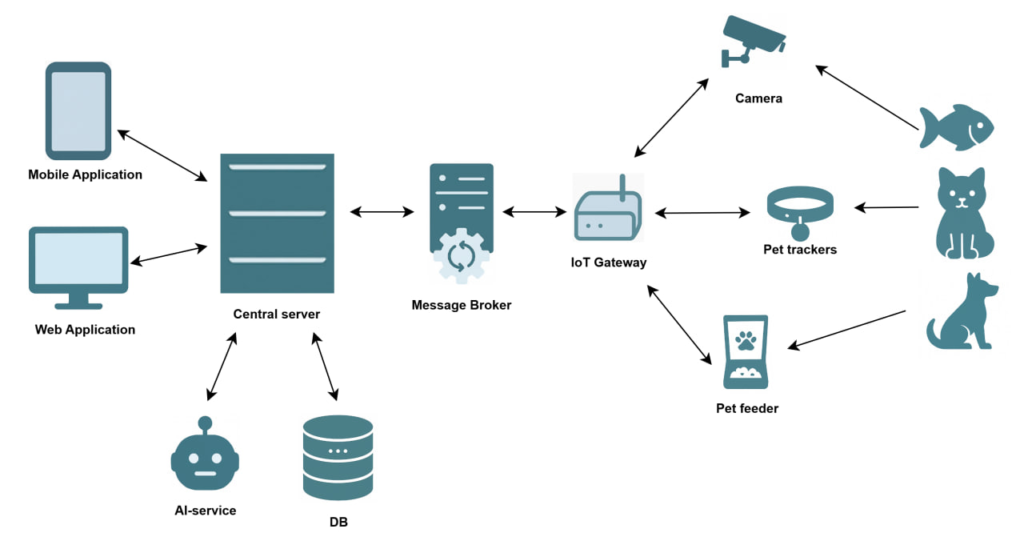
In pet care systems, it is crucial to combine the operation of physical devices for data collection, data processing, reliable server-side software, and a user-friendly interface. Overall, these systems can be divided into the following key components:
• IoT devices – examples of which were provided above. Their main functions are to perform specific actions, such as feeding, and to collect analytical data. This is the physical layer of the system, directly interacting with pets.
• IoT gateway – a hub through which all data collected from the devices passes, redirecting it to the processing server or other destinations. It can be either a physical device or cloud based. Basic filtering and data aggregation can be performed at this level.
• Server – the central unit for processing and managing the entire system. It may consist of multiple services if microservices architecture is used. This is where all data received from the gateway is processed. The server handles integration with APIs for the mobile app and other third-party services. It also has functionality for sending notifications to the pet owner or commands directly to smart devices. Additionally, it may include features for training and implementing AI for deeper data analysis.
• Database – used to store statistics, user information, photos/videos, and other data.
• Dedicated AI service – in some implementations, it makes sense to treat this as a separate service from the main server. It performs video analysis, for example, to determine the pet’s mood or activity level.
• Mobile app/Web interface – the client that provides a convenient interface for the owner to view collected data and statistics, as well as to directly control smart devices and other system components.
The schematic of this system can be described as follows:
Advantages of IoT Pet Care Systems
1. Remote care: you can feed your pet, check its condition, and see what’s happening in real time — even if you’re abroad or on the road.
2. Routine automation: regular feeding, water dispensing, door opening — all work on a schedule or event trigger without the owner’s involvement.
3. Safety and monitoring: cameras and sensors help detect unusual behavior (the pet is sick, sad, barking without reason, not eating, etc.).
4. AI behavior analysis: detecting changes in the pet’s mood or activity, enabling timely responses to warning signs.
5. Real-time notifications: push notifications about important events (food dispenser empty, water finished, pet hasn’t returned, etc.).
6. Customized scenarios: the ability to configure the system for specific needs, such as night mode, feeding four times a day, or blocking access to certain rooms.
Caution
Despite all the advantages, it’s important to remember that these systems have their limitations: they rely on a stable power supply and internet connection and can be quite expensive to implement and maintain. But most importantly, no matter how advanced an IoT system is, it can never replace live interaction and care from an owner — something every pet needs for its psychological and physical well-being. It’s essential to understand that these technologies should only be considered an additional aid for pet care when you’re away for a few hours or, at most, a day. They are absolutely not designed for situations where a pet is left alone for several days or longer. Such an approach can lead to stress, health issues, or even dangerous situations for your pet. Therefore, if you plan to be away for an extended period, you should arrange for someone to visit and personally care for your pet or temporarily leave it with friends or at a specialized pet hotel.
Where It’s Already Being Used
Today, there are many ready-made solutions around the world that show how modern IoT technologies can make pet care easier and keep owners constantly connected with their pets.
Geeni Smart Pet Feeder + Camera — a smart feeder with a built-in camera that allows owners to monitor feeding in real time via a mobile app. Users can set feeding schedules, watch live video from home, and receive notifications about every event. All data is processed through the Geeni Cloud infrastructure.
Petcube — a startup that combines a camera with an interactive laser for playing and artificial intelligence for analyzing pet behavior. The device can detect barking, whining, and other distress sounds, then send alerts to the owner. Additionally, it allows two-way communication with pets via a built-in microphone and speaker. Video processing and AI models run in the cloud.
Sure Petcare Smart Door — smart doors for cats and small dogs that only open for animals with a chip or tag. Through the mobile app, owners can see when their pet enters or exits and can manually lock or unlock the door.
Whistle Health & GPS Tracker — a GPS tracker with activity and health monitoring features. Owners receive detailed reports on their pet’s sleep, activity levels, and even eating habits. Data is transmitted to the owner’s smartphone via LTE or Wi-Fi.
These examples demonstrate how multifunctional solutions combine IoT devices, video analytics, mobile apps, and cloud technologies to ensure comfort, safety, and care for pets.
Conclusions
IoT systems for pet care are no longer a fantasy but a reality that helps owners provide comfort, safety, and attentive care to their pets even from a distance. Modern solutions combine hardware IoT devices (feeders, cameras, sensors), powerful servers, mobile applications, and AI modules for analyzing pet behavior. This enables automated feeding, activity tracking, alerts about unusual behavior, and real-time communication with the pet.
However, it’s important to recognize the limitations of such technologies: they rely on electricity and stable internet connections, require investment, and can never replace real human presence and care. Even the most advanced system is just a tool to assist owners, not a full replacement for being there in person. Leaving a pet alone for several days is a very bad idea, as it can negatively affect their psychological state and health. Therefore, these systems should be used wisely — not to deceive yourself into thinking they replace you, but to support your care for your beloved pets.