
✆ + 1-646-235-9076 ⏱ Mon - Fri: 24h/day
Will AI Replace You? What Each Role Should Actually Worry About

Every era of humanity has faced the challenges of technological progress. During the Industrial Revolution, people feared that machines would take away their jobs. In the 20th century, the same debates arose around computers. Today, it’s artificial intelligence’s turn.
These concerns are not unfounded!
AI has already transformed the way we work, communicate, and learn. Its emergence is not just about convenience or speed — it poses a significant challenge to millions of professions across various industries. Routine and repetitive tasks are particularly vulnerable, but even roles that require specialized knowledge, such as data analysis, financial reporting, and certain aspects of customer service, are increasingly being augmented or replaced by intelligent systems. Analysts estimate that by 2030, more than half of jobs worldwide could be automated. This means that in just five years, the economy as we know it may look completely different, with entire sectors undergoing restructuring, new skill sets becoming essential, and workers needing to adapt to a landscape where human creativity, critical thinking, and emotional intelligence will be the most valued assets. The speed of technological adoption suggests that businesses and individuals alike must prepare now for a future in which human labor and AI coexist, complementing each other while reshaping traditional career paths.
The scale of change
International organizations are sounding the alarm. For example, the World Economic Forum (WEF) predicts in its report that by 2030, AI will eliminate around 92 million jobs.
Meanwhile, McKinsey & Company estimates that about 800 million people worldwide could lose their jobs or require retraining.
Goldman Sachs, in turn, forecasts that generative AI could impact 300 million jobs in the U.S. and Europe. This is not only about job losses, but also about the transformation of the very nature of work.
On average, experts agree: roughly 25–30% of today’s jobs are at risk — that’s about one in three workers.
But is it really that scary?
Despite the pessimistic forecasts, the development of artificial intelligence should not be seen solely as a threat. According to the World Economic Forum, by 2030 AI could indeed eliminate around 92 million jobs. At the same time, however, technology is expected to create 170 million new jobs. This means the balance could even be positive — a net gain of 78 million jobs.
In other words, humanity will not be left without work, but the nature of that work will change. The focus will shift to professions that require creativity, strategic thinking, emotional intelligence, and technical skills to work with new systems.
Who is at risk?
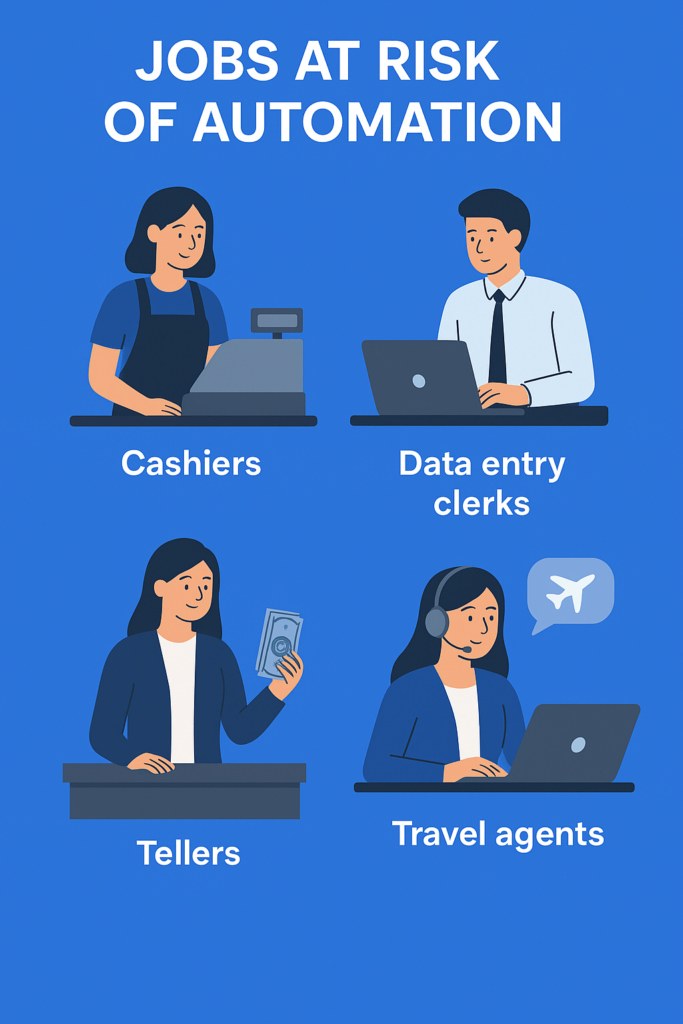
The most vulnerable are professions that involve routine, repetitive tasks. For example, cashiers — self-checkout lanes are becoming increasingly common in supermarkets. Today, in EU countries, the share of shoppers who check out by themselves exceeds 60%.
Secretaries and office managers are also at risk. Basic administrative functions — scheduling meetings, handling documents, responding to emails — can easily be automated. Entry-level financial analysts may also be replaced by AI. Data analytics was one of the first areas where AI outperformed humans; algorithms can analyze stock trends or detect risks faster than a person.
Packers and sorters are also at risk. In Amazon’s logistics centers, tens of thousands of robots already replace humans in physical work. Even news journalists are under threat — AI can already create short news reports. For example, the Associated Press automated the writing of financial summaries back in 2015.
Real Cases of AI Replacing Humans
The replacement of human workers with artificial intelligence is no longer a prediction from futuristic reports — it is a present-day reality. More and more companies openly admit that implementing algorithms allows them to significantly reduce personnel costs.
A striking example is China: in the video game industry, generative AI has effectively eliminated almost 70% of jobs for illustrators. Whereas dozens of artists used to work on creating characters and visual elements, now an algorithm can generate entire worlds, locations, and avatars in just a few minutes. This has sharply reduced the need for manual graphics specialists, calling into question the existence of an entire profession as it was previously known.
A similar situation occurred in Australia at the end of 2024. Just before Christmas, a number of medical receptionists received news of layoffs: their functions — answering calls, registering patients, and advising on schedules — were transferred to a new AI-based phone system. This system operates 24/7, does not tire, never makes errors in data, and costs hospitals dozens of times less. For patients, this meant faster service, but for employees, it meant losing their jobs just a few days before the holidays.
In Europe, artificial intelligence is also being actively tested in the banking sector. There, chatbots already handle customer service by responding to typical requests: account balances, deposit terms, card blocking. Just a few years ago, these tasks were performed by call center employees, but now hundreds of such positions have been eliminated. Banks officially state that automation has significantly reduced operational costs while providing customers with round-the-clock access to services.
A particularly striking case took place in the USA. In 2025, IBM announced a sharp reduction of about 8,000 employees, mainly in HR. They were replaced by AI agents capable of performing nearly the entire range of routine tasks: from document processing and payroll preparation to responding to employee inquiries. According to official data, the new “Ask HR” tool automated up to 94% of all processes previously handled by human specialists. This became one of the most notable examples of how even large international corporations, long considered symbols of stability, are massively reducing personnel under the influence of artificial intelligence.
All these cases demonstrate that AI is already radically transforming the labor market. What just a few years ago seemed like predictions has now become everyday reality: robots and algorithms are gradually taking over human functions across a wide range of fields — from creativity and medicine to finance and corporate management.
Professions of the Future: What Machines Won’t Replace
Not all professions are susceptible to automation, as there are areas where the human factor remains key and irreplaceable. First and foremost, this applies to medicine and caregiving. A robot or algorithm can make an accurate diagnosis based on tests or scans, but it cannot provide warmth, empathy, or moral support to a patient. For a sick person, it is important not only to receive the correct treatment but also to feel the care of a doctor or nurse — an aspect that no machine can yet replicate. A similar situation exists in the field of social care for the elderly or children: emotional connection and attentiveness remain exclusively human traits.
In education, we should not expect a complete replacement of teachers. Yes, artificial intelligence can help create educational materials, grade tests, or adapt assignments to a student’s level. But it cannot inspire, motivate, or act as a mentor who sees a child’s potential and helps unlock it. A teacher does more than impart knowledge — they shape personality, teach teamwork, and cultivate critical thinking. These are complex tasks requiring empathy, life experience, and a deep understanding of psychology, and their automation is unlikely.
Creative professions also occupy a special place. AI can already generate music, write texts, create drawings or designs. But true originality, a unique style, and the depth of artistic vision remain the prerogative of humans. Artists, writers, directors, and musicians infuse their works with emotion, personal experience, and cultural context, making them unique. A machine can imitate a style, but it cannot create something that evokes genuine awe or catharsis in a human being.
Additionally, many professions involve physical work on-site that constantly requires improvisation. For example, repair work, emergency services, construction, or military service. These roles require flexibility, rapid response, and unconventional decision-making — all very difficult to program. Robots can assist, but control and responsibility still rest with humans.
Finally, the paradox of the future is that the development of artificial intelligence itself creates demand for new professions. There is growing demand for specialists in programming and AI training, ethical experts to regulate the use of technology, and professionals who combine knowledge from different fields — from psychology to robotics. It turns out that the more automation we implement, the greater the need for people who can manage these systems and guide their development in the right direction.
Positive Aspects of AI Development
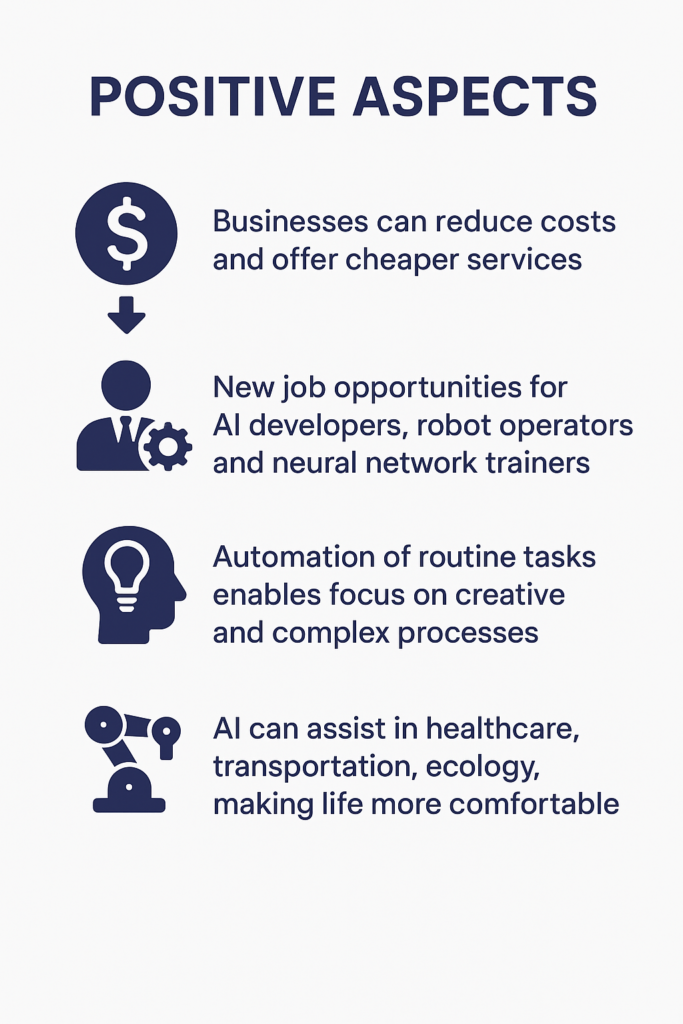
However, AI not only poses threats but also opens up new opportunities. For businesses, this means reduced personnel costs and optimized processes. Automation allows companies to operate faster, more accurately, and more cheaply, enabling them to offer consumers more affordable products and services. This is particularly important for small and medium-sized enterprises, which can compete with large corporations through AI implementation.
Moreover, the development of artificial intelligence creates entirely new professions that did not exist before. There is already growing demand for algorithm developers, data analysts, robot operators, cybersecurity specialists, and trainers for neural networks who “teach” systems to process information. In other words, even if some old professions disappear, they will be replaced by new ones that require modern skills. This will encourage people to retrain and acquire new knowledge, which in the long term will contribute to societal development.
Equally important is the fact that AI takes on routine and monotonous tasks. This allows humans to focus on what machines cannot do: creativity, strategic thinking, team management, and innovation development. For example, in medicine, artificial intelligence helps doctors analyze scans and test results more quickly, allowing them to focus on patient care. In transportation, AI can optimize logistics, reduce accidents, and make travel easier. In environmental science, it can forecast climate changes and suggest solutions for nature conservation. All these advantages demonstrate that artificial intelligence can make our lives more comfortable, safer, and productive.
Conclusion
Artificial intelligence is both a challenge and an opportunity. By 2030, the world of work will change dramatically. Some professions will disappear, while others will emerge. Those who are ready to learn, adapt, and embrace new technologies will succeed in this race.
The future does not necessarily mean total unemployment. It means a transformation in which the main competitor for humans will not be machines, but their own flexibility, capacity to learn, and creativity.