
✆ + 1-646-235-9076 ⏱ Mon - Fri: 24h/day
Water Management in Smart Cities: IoT-Enabled Leak Detection and Conservation

Up to 30% of treated urban water is lost before reaching consumers, costing utilities billions and straining limited resources. With water scarcity already affecting over 2 billion people, cities urgently need smarter management.
The Internet of Things (IoT) offers a solution. Networks of sensors, meters, and analytics platforms now allow real-time monitoring, leak detection, and optimized use.
This article explores how IoT is transforming urban water systems- from identifying hidden leaks to enabling smart irrigation – along with the environmental and economic benefits it brings.
Why Smart Water Management Matters Today?
Cities across the globe are facing mounting water challenges. Climate change is intensifying droughts, heatwaves, and erratic rainfall, while urbanization is driving up demand for both residential and industrial water use. At the same time, many municipal systems rely on outdated infrastructure – with aging pipelines and limited monitoring tools.
The result?
- Frequent breakdowns and pipe bursts cause billions in annual damages
- Chronic leaks waste millions of liters of treated water daily
- Cities lose ~$14 billion/year in Non-Revenue Water – water that’s pumped, purified, and then lost before reaching users
Technology Meets Urgency
The good news is that as problems escalate, so do solutions. Rapid advances in IoT and wireless communication now allow cities to modernize without overhauling entire systems:
- Affordable sensors with ultra-low energy consumption
- Wireless standards like LoRaWAN, NB-IoT, and Wi-SUN support large-scale deployments
- Cloud platforms and AI enable real-time monitoring and anomaly detection
What seemed futuristic a decade ago is now standard:
Cities are implementing smart meters, pressure sensors, moisture detectors, and water quality monitors – all connected to digital dashboards that optimize system performance.
The Environmental Cost of Inefficiency
Water waste isn’t just a financial issue – it’s also an emissions problem:
- Every m³ of lost water equals ~10.5 kg of CO₂, due to energy-intensive pumping and treatment
- 30-40% of a city’s electricity is consumed by water and wastewater systems
This means smarter water management doesn’t just save water – it reduces carbon footprints and contributes to climate action.
Detecting Water Leaks with IoT
Water leaks are among the most common and costly problems in urban networks. In traditional systems, they are often detected only when visible damage has already occurred. IoT changes this approach: smart sensors continuously monitor pipelines and identify anomalies in real time. This allows utilities to move from reactive actions to proactive management.
How the Technology Works
Several types of sensors are used:
- Acoustic – detect noise and vibrations from leaks.
- Pressure and flow – identify imbalances in water distribution.
- Thermal and electromagnetic – detect underground moisture.
They are often combined and enhanced with AI algorithms for greater accuracy.
Practical Effect
In one city, where losses reached 39%, instead of building a new pipeline, acoustic sensors were installed. Within six months, 21 leaks were detected and repaired, saving 288,000 m³ of water (~$177,000) and reducing losses to 29%. This quickly paid off the investment and postponed expensive infrastructure projects.
Benefits for Cities
- Leaks are detected within minutes, not weeks.
- Teams receive precise coordinates and can respond immediately.
- Dynamic pressure regulation and predictive maintenance reduce accident risks.
- Systems provide transparent data: from instant alerts to long-term trends for planning.
As a result, cities gain not only resource savings but also fewer accidents, lower maintenance costs, and more resilient infrastructure.
Real-Time Consumption Monitoring and Smart Meters
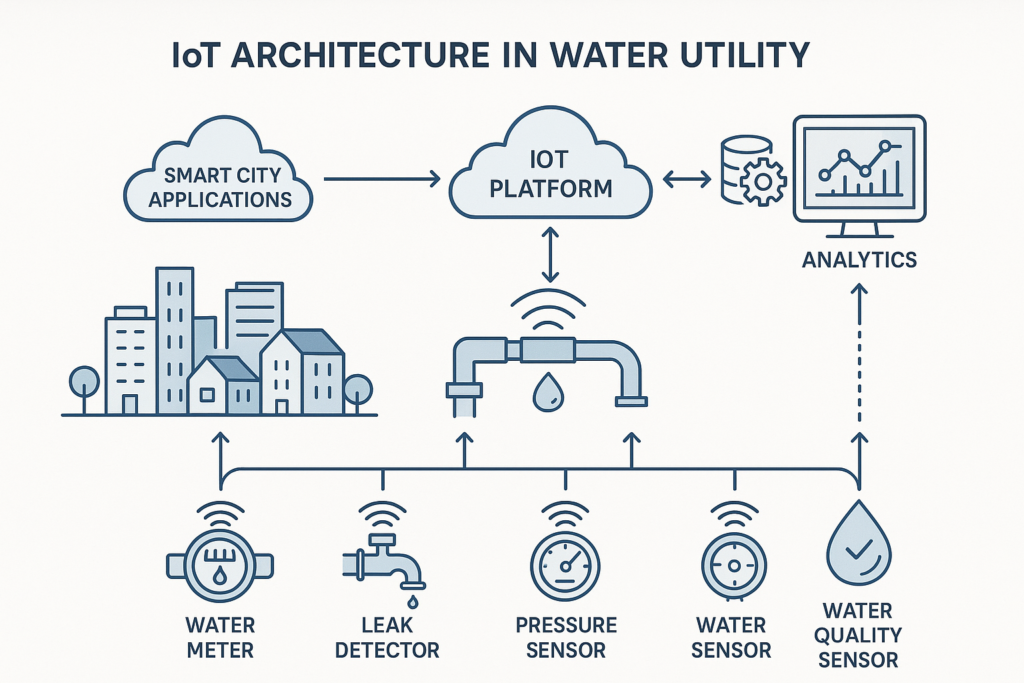
Source: Image generated via ChatGPT 5 by Volodymyr Kazakov
Smart water management is not only about quickly fixing leaks but also about controlling how water is consumed. Smart meters and real-time monitoring systems play a key role here. They enable utilities to detect anomalies on time and help residents manage their consumption more efficiently.
From Manual Readings to Real-Time Data
Mechanical meters have long been replaced by Automated Meter Reading (AMR) systems. However, AMR only provides periodic data, meaning leaks can go unnoticed for weeks. Modern AMI systems transmit data hourly or even more frequently, which makes it possible to:
- instantly detect consumption spikes or unauthorized usage;
- localize anomalies at the level of specific network segments;
- prevent accidents and resource losses.
Communication Technologies
Traditional Wi-Fi or cellular networks often perform poorly underground, so cities are switching to LPWAN solutions:
- LoRaWAN – long-range coverage with low power consumption;
- Wi-SUN – mesh networks for dense urban areas.
These devices can operate autonomously for 5-7 years, ensuring stable data transmission.
Benefits for Cities and Residents
Smart meters bring value to all parties:
- For utilities – no human errors, faster leak detection, and the ability to introduce dynamic tariffs.
- For consumers – mobile apps with real-time data, automatic alerts (“possible night leak”), and personalized tips for saving water.
Practical Example
One city’s parks department, after installing smart meters, was able to remotely track water consumption, optimize irrigation schedules, and immediately respond to leaks. The result: 20% reduction in water usage and $860,000 annual savings.
Data Analytics and Water Usage Optimization
Smart sensors generate vast amounts of data, but analytics transforms it into clear, actionable insights. Central platforms collect readings on flow, pressure, and water quality, often enriched with weather forecasts or even digital twins of the network.
Key capabilities include:
- Real-time operations: leak alerts, anomaly detection, pressure drops
- Forecasting: predicting demand during dry seasons, events, or heatwaves
- Optimization: identifying high-loss areas, prioritizing repairs, and guiding conservation programs
Artificial intelligence strengthens these processes by recognizing patterns in historical data, predicting failures before they occur, and distinguishing between normal use and emergencies.
Analytics also connects water management with other smart city systems – pausing irrigation ahead of rainfall, comparing pump station energy use with flows, or coordinating stormwater and drinking water systems. Because these platforms manage critical infrastructure, strong cybersecurity (encryption, authentication, redundancy) is a must.
Analytics is the brain of a smart water network. It guides utilities on when to act, how to optimize resources, and where to improve efficiency – turning raw sensor data into smarter, more sustainable decisions.
Smart Irrigation and Efficient Water Use
Urban irrigation – watering parks, lawns, and gardens – uses a large share of municipal water, yet much of it is wasted through inefficient practices like watering at midday, running during rainfall, or missing leaks. IoT technologies make irrigation smarter by delivering just the right amount, at the right time.
Smart systems combine soil moisture sensors, weather data, and IoT controllers that automatically adjust schedules. For example, watering is skipped if rain is forecast, or shifted to early morning and evening on hot days to reduce evaporation. Each zone is connected to a controller, activity is logged, and manual overrides remain possible.
Key benefits include:
- Reduced waste: avoiding overwatering, detecting leaks instantly
- Transparency: tracking every liter used for better optimization
- Savings: trials show 20 – 40% reductions in water use without harming plants
At scale, this means millions of cubic meters saved each year, while building resilience against droughts and ensuring essential water for drinking and hygiene.
Beyond irrigation, similar IoT monitoring improves efficiency in building systems, street cleaning, fountains, and even industry. Still, irrigation remains the most visible and impactful use case – cutting costs, conserving water, and maintaining green spaces under climate pressure.
Challenges and Recommendations for Cities Implementing IoT-Based Water Solutions
The benefits of IoT in water management are clear, but implementation brings financial, technical, and organizational challenges. Addressing these effectively ensures long-term success.
- Funding and ROI: High upfront costs for sensors, networks, and training can slow adoption. Cities should begin with small pilot projects in high-loss areas, prove savings, and use the results to secure wider funding through grants or partnerships.
- Integration with Legacy Systems: Full replacement of old infrastructure is rarely feasible. Modular, open-architecture platforms that connect with existing equipment allow phased rollouts – starting with meters, then analytics, and later automation.
- Workforce and Culture: Digital transformation depends on staff readiness. Early training, staff involvement, and dedicated digital teams help build ownership and reduce resistance.
- Cybersecurity: Connected infrastructure must be protected. Encryption, authentication, and regular updates should be built into the system from the start.
- Scaling and Standardization: Citywide deployments risk fragmentation if different technologies are used. A clear digital water strategy, with shared standards and open protocols, ensures interoperability and future expansion.
Ultimately, technology alone is not enough. Strong leadership, transparent communication, and visible results – like fewer outages and accurate billing – help build public trust and turn IoT water systems into a foundation for sustainable urban growth.
Examples of IoT Solutions for Urban Water Resource Management
Barcelona (Spain) – Smart Meters and Leak Detection
Barcelona was one of the first European cities to integrate IoT into its water supply as part of its smart city vision. Thousands of smart meters and leak detection sensors were installed to continuously track pressure and flow across the pipeline network, with data sent directly to a central control platform.
This real-time monitoring made it possible to detect hidden leaks in the city’s aging infrastructure, reducing water loss by around 25% in just two years. The system not only conserved resources but also cut costs and ensured a more sustainable supply for residents.
The project, led by the municipality in partnership with technology providers, showed how IoT can turn a conventional water network into intelligent infrastructure capable of automatically identifying and addressing inefficiencies.
Sources: Example of a Smart City: A Case Study into Barcelona
Liège (Belgium) – IoT and LoRaWAN in the CILE Water Utility
In Liège, the CILE water utility has modernized its network using IoT and LoRaWAN. Over 250,000 sensors – including smart meters, pressure, and flow sensors – are connected through Cisco IXM gateways to monitor consumption, pressure, leaks, and reverse flows in real time.
Data is sent to an analytics platform integrated with SAP, where alerts and insights guide operations. By dividing the network into sectors, CILE can compare water volumes, detect losses, and prioritize repairs on leak-prone pipelines.
The system has improved efficiency and sustainability: reservoirs are now filled with only the required amount, avoiding overflows, while automated billing eliminates manual meter readings.
Developed with Cisco and NTT, the project strengthened water resource management in the Liège region, offering continuous visibility, faster response to anomalies, and a strong foundation for long-term sustainability.
Sources: CILE boosts water conservation with IoT and LoRaWAN
Singapore – Smart Water Grid with Advanced Analytics
Singapore’s Smart Water Grid uses IoT sensors across its municipal network to track pressure, flow, and water quality in real time. Data is sent to a central analytics platform that detects anomalies, identifies leaks early, and optimizes distribution to reduce non-revenue water (NRW).
Implemented by the national water agency PUB with partners such as the WaterWiSe platform, the initiative has cut water losses by about 15%, generating major cost savings. Real-time monitoring also enables rapid responses – rerouting flows during peak demand or repairing pipes before failures.
By creating a digital twin of its water infrastructure, Singapore has improved supply reliability, strengthened resilience, and set a global benchmark for smart urban water management.
Sources: Smart Water Systems: Harnessing Technology for Sustainable Urban Water Management
Conclusion
The Internet of Things is reshaping urban water management. With smart sensors, real-time monitoring, and AI analytics, utilities can detect leaks quickly, optimize distribution, and plan infrastructure more efficiently – resulting in less waste, lower costs, and stronger resilience.
Success, however, requires strategy, investment, and robust cybersecurity. Cities that start small – piloting IoT in high-impact areas – prove the value and unlock wider adoption.
Ultimately, smart water management is more than a technological upgrade. It is a step toward sustainability, transparency, and public trust, ensuring that every drop counts in building greener, climate-resilient cities.