
✆ + 1-646-235-9076 ⏱ Mon - Fri: 24h/day
Smart Ambulances How IoT is Redefining Emergency Response

Today, emergency medicine faces numerous challenges that significantly affect the quality and speed of care delivery. One of the main issues is delays in ambulance response, often caused by insufficient coordination between dispatch centers and crews on the route. Dispatchers frequently receive only limited information about the patient’s condition before the team arrives, making it harder to make the right decisions in critical situations. As a result, doctors and paramedics may not have enough time to prepare the necessary equipment or plan the optimal route, and the patient may not receive timely care.
Another common challenge in many regions is the lack of patient data before hospitalization. Without access to medical history, vital signs, or disease progression, doctors are often forced to work in uncertainty. This increases the risk of complications and may lead to more hospitalizations or adverse outcomes for the patient.
In this context, the role of digital technologies becomes especially important, as they can improve both the speed and effectiveness of response. The use of modern information systems, sensors, and communication tools helps reduce decision-making time, enables the rapid transfer of patient data, and improves coordination among all participants in the care process.
One of the most promising directions is the integration of IoT and smart technologies into ambulance services. Modern smart ambulances can be equipped with sensors to monitor vital signs, GPS and telemetry for route tracking, telemedicine systems for real-time consultations with doctors, and AI-powered analytics to predict patient conditions and optimize crew actions. These technologies transform a traditional ambulance into an intelligent mobile medical station that not only transports the patient but also actively supports their condition on the way to the hospital, increasing the chances of timely and effective treatment.
The implementation of smart solutions in emergency medicine opens up new opportunities: reducing response time, improving patient safety, and allowing for more efficient use of healthcare system resources. This is why the integration of IoT and modern digital technologies into ambulance operations is becoming a key development trend in emergency medicine worldwide, gaining importance in both urban and rural areas.
What is a Smart Ambulance?
A Smart Ambulance is a modern emergency vehicle equipped with integrated sensors and IoT devices that enable real-time monitoring of a patient’s condition. This approach transforms a traditional ambulance into a mobile medical station capable of collecting, transmitting, and analyzing data during patient transport.
The concept is built on the integration of several technologies. IoT devices and sensors continuously track vital signs such as heart rate, blood pressure, oxygen saturation, and temperature. GPS modules and telemetry allow real-time tracking of the ambulance’s location and provide information on optimal routes based on traffic conditions. Telemedicine enables hospital doctors to consult the on-site team remotely and make informed decisions before the patient arrives. AI analytics and Big Data help predict changes in the patient’s condition, assess risks, and provide personalized recommendations for the medical team.
Key advantages of the Smart Ambulance include significantly reduced response times through optimized routing, continuous monitoring of vital signs during transport, direct transmission of data to hospitals to help medical staff prepare in advance, and improved decision-making through predictive analytics.
In essence, the Smart Ambulance combines the mobility of traditional emergency vehicles with the power of modern digital technologies, delivering fast, accurate, and personalized medical support even before the patient reaches the hospital.
The Role of IoT in Smart Ambulances
The Internet of Things (IoT) plays a crucial role in transforming traditional ambulances into modern Smart Ambulances. Its primary function in this context is to enable the continuous collection, transmission, and processing of patient data and crew movement in real time.
Sensors installed inside the vehicle allow for constant monitoring of the patient’s vital signs. Among the most common devices are ECG monitors, SpO₂ sensors, blood pressure monitors, body temperature sensors, and other biomedical instruments. This data provides the medical team with accurate, real-time insights into the patient’s condition, enabling quick reactions to changes and critical decision-making during transport.
Equally important are GPS modules and telemetry systems, which track the ambulance’s location and determine optimal routes. Traffic and road condition data are transmitted to a central dispatch center, allowing for coordination among multiple crews, avoidance of traffic jams, and shorter arrival times.
Data collection and transmission in real time are carried out through dedicated IoT gateways and communication modules. Modern LTE/5G modules are most commonly used, ensuring stable information exchange even in remote or hard-to-reach areas. This approach allows sensor data to be sent directly to hospitals or dispatch centers, where it is integrated with electronic medical records and analytics systems.
In this way, IoT in Smart Ambulances ensures continuous patient monitoring, precise vehicle tracking, and uninterrupted data transmission — significantly improving the efficiency of emergency care and increasing the chances of saving lives.
AI and Analytics in Smart Ambulances
Artificial Intelligence (AI) and analytics play a critical role in enhancing the efficiency of Smart Ambulances. During patient transport, AI systems can predict the progression of a patient’s condition, assess the risk of complications, and alert the crew to take urgent action. Through machine learning algorithms, potential changes in vital signs can be anticipated, with recommendations for the best steps to stabilize the patient before arriving at the hospital.
Beyond prediction, AI provides real-time decision support by suggesting first aid measures and prioritizing actions based on incoming data. For example, the system may recommend immediate administration of specific medications, adjustments to ventilation settings, or cardiopulmonary resuscitation (CPR) depending on the patient’s condition. Such recommendations reduce the likelihood of errors and increase efficiency, even in high-stress situations.
Another important AI function is route optimization. By analyzing traffic data, road conditions, time of day, and potential congestion, algorithms suggest the fastest and safest path to the patient and then to the hospital. This minimizes response time and improves the chances of a positive outcome.
Integration with Electronic Health Records (EHR) and medical databases enables AI systems to access comprehensive information about a patient’s medical history, allergies, prior treatments, and current medications. This ensures more accurate personalization of recommendations and allows the crew to act with maximum effectiveness.
In this way, AI and analytics in Smart Ambulances not only improve the accuracy and speed of medical decision-making but also transform emergency care into a proactive, predictive, and personalized system — significantly increasing the chances of saving patients’ lives.
System Architecture
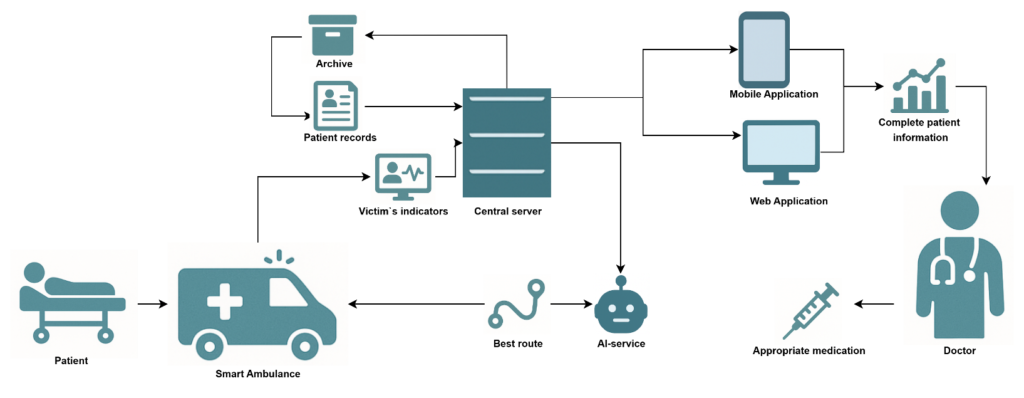
The architecture of a Smart Ambulance is built on a multi-layered structure that enables real-time data collection, transmission, processing, and visualization. At the lowest level are sensors and monitoring devices that capture vital patient parameters such as ECG, blood pressure, SpO₂, temperature, and other biomedical indicators. This data is transmitted through an IoT gateway, which aggregates the information and ensures its reliable transfer to a cloud or hybrid platform.
The cloud infrastructure, or its hybrid version, serves as the central hub for storing and processing data, as well as integrating it with analytics systems and AI/ML models. Artificial Intelligence and Machine Learning are used to predict the patient’s condition, provide recommendations to medical teams and dispatchers, and optimize ambulance routes based on real-time traffic data and historical patterns.
The backend of the system is implemented in Java using Spring Boot, providing a reliable and scalable server layer. Data exchange is supported through protocols such as MQTT, REST, or WebSocket, depending on real-time requirements. Information storage is handled through both relational and non-relational databases, such as PostgreSQL and MongoDB, enabling efficient processing of structured data as well as time-series streams.
Additionally, APIs are provided for mobile and web applications, allowing dispatchers, doctors, and ambulance crews to access real-time data, review historical records, and receive alerts about critical changes in the patient’s condition. Visualization is supported through interactive dashboards, charts, and mobile apps, enabling rapid assessment of the patient’s status and informed decision-making while on the move.
Overall, the system structure can be graphically represented as follows:
Example use cases and system benefits:
- Real-time monitoring of patient vital signs
- Ambulance crews and hospitals receive up-to-date patient data before arrival.
- Enables rapid response to critical changes and reduces the risk of complications.
- Prediction of patient condition progression
- AI models assess the likelihood of deterioration or complications.
- Helps dispatchers and doctors plan necessary actions in advance.
- Ambulance route optimization
- GPS, telemetry, and AI analytics are used to select the fastest and safest route.
- Reduces response times and improves resource efficiency.
- Data transmission to hospitals and EHR integration
- Hospitals gain access to patient history and real-time vitals before the ambulance arrives.
- Simplifies preparation of equipment, medication, and medical staff.
- Automated alerts and recommendations for the crew
- The system notifies about critical changes and suggests first aid actions.
- Reduces the likelihood of errors and improves the quality of care.
- Data visualization for dispatchers and doctors
- Interactive dashboards provide a quick overview of multiple patients simultaneously.
- Enhances decision-making speed and coordination across teams.
- Support for mobile and web applications
- Data and analytics are accessible from anywhere via smartphone or tablet.
- Allows doctors and dispatchers to monitor situations remotely, even while attending other calls.
Implementation in Real-World Conditions
The deployment of Smart Ambulances requires consideration of local conditions and infrastructure availability. In urban areas, it is essential to ensure integration with existing dispatch centers, optimize routes with traffic data, and connect the system to Electronic Health Records (EHR). In rural regions, the main challenges are limited mobile internet coverage and the distance to medical facilities, which necessitate hybrid solutions with local gateways and backup data transmission channels via LTE or satellite communication.
For a Smart Ambulance to function effectively, the following equipment is required: medical sensors (ECG, SpO₂, blood pressure monitors, temperature sensors), GPS modules, IoT gateways, LTE/5G/NB-IoT communication modules, servers for data storage or access to cloud platforms, as well as mobile or web applications for dispatchers and doctors. The estimated implementation budget depends on configuration and project scale: a basic system can start from tens of thousands of dollars per vehicle, while full integration with dispatch services and hospitals may range from hundreds of thousands of dollars and above.
At the same time, there are several challenges to address. First, mobile internet coverage in remote areas may limit the effectiveness of real-time data transmission. Second, it is necessary to ensure the security of medical data, including encryption during transmission and storage in compliance with HIPAA or GDPR standards. Third, medical devices and sensors must be certified and meet healthcare standards to guarantee accurate measurements and patient safety.
When properly implemented, Smart Ambulances can significantly improve the efficiency of emergency care, reduce response times, and increase patient safety. However, successful deployment requires a comprehensive approach that takes into account technical, regulatory, and organizational factors.
Real Use Cases
1. Philips Smart Ambulance (Europe): Philips is actively integrating IoT and telemedicine technologies into emergency medicine. Their solutions include the use of telemedicine platforms for real-time patient monitoring, allowing doctors to access patient data before arrival at the hospital. This enables faster and more accurate decision-making, reduces response times, and improves treatment outcomes. In particular, Philips’ eICU program leverages analytics and predictive algorithms to support decision-making in intensive care units.
2. ZOLL Medical / Corpuls (USA/Germany): these companies offer mobile patient monitoring systems with AI support, which include monitors/defibrillators that provide real-time feedback during cardiopulmonary resuscitation (CPR). These devices allow emergency teams to receive patient data in real time, improving coordination and the efficiency of care delivery. ZOLL’s software, such as RescueNet® CodeNet®, enables post-event data analysis, helping to optimize processes and enhance the quality of care.
3. Excelerate (United Kingdom): during the COVID-19 pandemic, Excelerate developed a smart ambulance system equipped with 5G and augmented reality technologies. This allows medical staff to access visualizations of a patient’s medical history and individualized treatment plans in real time. Such innovations improved coordination and efficiency in providing care during emergency situations.
Conclusion
The implementation of Smart Ambulances, combined with IoT and AI, significantly accelerates emergency medical care and increases the chances of saving patients’ lives. By integrating sensors, telemedicine, and analytical algorithms, doctors and dispatchers can respond quickly to critical situations, access real-time patient data before the ambulance arrives, and make informed decisions.
These technologies enable a proactive approach in emergency medicine, allowing complications to be anticipated and care to be provided even before symptoms become critical. They also improve coordination among ambulance crews, dispatch centers, and hospitals, optimize routes, reduce response times, and enhance resource efficiency.
It is expected that in the coming years, the number of innovative solutions in this field will continue to grow. Advances in 5G, IoT, and AI will enable the development of even more integrated and efficient emergency response systems, significantly improving patient safety and the quality of healthcare services worldwide.